
Building a Cyber-Aware Culture: Your Top Questions Answered
📌 General Questions About Cyber-Aware Cultures
❓ What is a cyber-aware culture?
A cyber-aware culture is an organisational environment where every employee, regardless of role, understands cyber risks, recognises threats, and takes proactive steps to mitigate them. It’s not just about technology or policies; it’s about mindset, habits, and shared responsibility. Think of it as turning every employee into a “human firewall.”
Key Traits:
✔ Security is everyone’s job (not just IT’s).
✔ Vigilance is encouraged and rewarded.
✔ Mistakes are learning opportunities, not punishable offenses.
✔ Leadership sets the tone with visible commitment.
❓ Why is a cyber-aware culture important?
Because 85% of breaches involve human error (Verizon DBIR). No firewall, encryption, or AI tool can fully eliminate human risk. A strong cyber-aware culture:
✅ Reduces breaches (organisations with strong security cultures see 5x fewer incidents – IBM Cost of A Data Breach Report.
✅ Improves compliance (avoids GDPR, NIS2, or UK Data Protection Act fines).
✅ Boosts employee confidence (staff who understand risks are less likely to panic or make mistakes).
✅ Protects reputation (customers and partners trust businesses that prioritise security).
❓ How is a cyber-aware culture different from cybersecurity training?
Cyber-Aware Culture | Cybersecurity Training |
Mindset shift – Security is ingrained in daily habits. | Skill-building – Focuses on teaching specific actions (e.g., spotting phishing emails). |
Ongoing, organisation-wide – A cultural norm, not a one-time event. | Structured, often role-specific – E.g., MFA training for IT, fraud awareness for finance. |
Proactive – Employees anticipate and report threats before they cause harm. | Reactive – Often triggered by compliance requirements or past incidents. |
Measured by behaviour (e.g., reporting rates, phishing test results). | Measured by completion (e.g., % of employees who finished a course). |
Example: A cyber-aware culture means an employee questions a suspicious email even if they’ve never been trained on that exact scenario. Training teaches them how to spot phishing; culture ensures they do it instinctively.
📌 Getting Started: Building the Foundation

❓ How do I start building a cyber-aware culture?
Follow this 5-step roadmap:
Assess Your Current State
- Run a phishing simulation (e.g., KnowBe4’s Free Test).
- Survey employees on their security knowledge and attitudes.
- Review past incidents (e.g., how many breaches involved human error?).
Secure Leadership Buy-In
- Present data on breach costs (e.g., £4.5M average per breach – IBM Cost of A Data Breach Report).
- Tie cybersecurity to business goals (e.g., customer trust, compliance, operational resilience).
Develop a Training Plan
- Awareness: Posters, emails, town halls.
- Education: Workshops, e-learning (e.g., LinkedIn Learning).
- Training: Phishing simulations, incident response drills.
Launch Pilot Programs
- Start with high-risk departments (e.g., finance, HR, customer support).
- Use gamification (e.g., rewards for top performers).
Measure & Iterate
- Track phishing test failure rates, training completion, incident reporting.
- Adjust based on feedback and metrics.
Pro Tip: Start small but think big. Even one phishing test or a 30-minute workshop can spark cultural change.
❓ How do I get leadership on board?
Speak their language; focus on business impact, not technical jargon.
🔹 Use data:
- “85% of breaches involve human error” (Verizon DBIR).
- “Companies with strong security cultures see 5x fewer breaches” (IBM Cost of A Data Breach Report).
- “The average breach costs £4.5M” (and reputational damage is priceless).
🔹 Tie to business goals:
- Customer trust: “A single breach can lose us 60% of our customers” (PwC).
- Compliance: “GDPR fines can reach 4% of global revenue—training reduces that risk.”
- Operational resilience: “Downtime from a breach averages 22 days” (Ponemon).
🔹 Show quick wins:
- Run a free phishing test and present the results.
- Share case studies (e.g., “Barclays reduced phishing clicks by 40% with a cultural shift”).
🔹 Make it personal:
- “If your email were hacked, could an attacker impersonate you to steal £1M?”
“Investing £20K in cybersecurity awareness training could save us £4.5M in breach costs, and protect our reputation. Can we pilot a program with the finance team?”
❓ What’s the first training I should roll out?
Start with the biggest, most common threat: phishing.
Why?
- 90% of breaches begin with phishing (CISA).
- Easy to measure (e.g., click rates, reporting rates).
- Engaging for employees (they’ll see immediate relevance).
How?
- Run a baseline phishing test (e.g., via KnowBe4 or Proofpoint).
- Train employees on:
- How to spot phishing emails (e.g., urgent language, mismatched URLs, suspicious sender addresses).
- What to do if they click (e.g., report immediately, don’t enter credentials).
- Reinforce with microlearning (e.g., weekly tips, quizzes).
- Retest monthly and track improvements.
Next Steps:
- Password hygiene training (e.g., MFA, password managers).
- Social engineering awareness (e.g., fake phone calls, USB drops).
❓ How do I assess my organisation’s current cyber-aware culture?
Use a multi-layered approach to gauge your starting point:
Quantitative Metrics
- Phishing test failure rate (Target: <5%).
- Training completion rates (Target: >90%).
- Incident reporting speed (How quickly are suspicious emails/activities reported?).
- Password hygiene audit (e.g., % of employees using MFA, weak/reused passwords).
Qualitative Assessments
- Employee surveys (e.g., “Do you feel confident identifying a phishing email?”).
- Focus groups (Gather anecdotal insights on security behaviours).
- Observational checks (e.g., Are employees locking screens, questioning unusual requests?).
Third-Party Audits
- Penetration testing (e.g., social engineering tests).
- Compliance assessments (e.g., ISO 27001, GDPR readiness).
Tools to Use:
- Free: NCSC’s Exercise in a Box (simulates cyber incidents).
- Paid: KnowBe4’s Security Awareness Assessment (measures human risk).
Pro Tip: Compare your results to industry benchmarks (e.g., KnowBe4’s Phishing Benchmarking Report).
❓ What are the most critical cybersecurity topics to train employees on?
Prioritise these high-impact areas based on risk and relevance:
Topic | Why It Matters | Training Examples |
Phishing & Social Engineering | #1 cause of breaches (90% of attacks start here). | Simulated phishing emails, real-world examples (e.g., CEO fraud, invoice scams). |
Password Hygiene | Weak passwords are a top attack vector. | MFA setup, password manager training, ban on password reuse. |
Multi-Factor Authentication (MFA) | Reduces account takeover risk by 99.9% (Microsoft Security Blog). | How to enable MFA on all accounts (email, VPN, cloud apps). |
Remote Work Security | Hybrid work = more vulnerabilities (e.g., unsecured Wi-Fi, personal devices). | VPN usage, home network security, secure file sharing. |
Data Protection & GDPR | Non-compliance = hefty fines (up to 4% of global revenue). | How to handle sensitive data, reporting breaches, right to be forgotten. |
Incident Reporting | Early detection = faster response. | How/when to report suspicious activity, no-blame culture. |
USB & Device Security | Malicious USB drops are a growing threat. | Never plug in unknown USBs, device encryption. |
Ransomware Awareness | Ransomware attacks surged 13% in 2023. | How to spot ransomware, what to do if infected. |
Supply Chain Risks | Third-party breaches (e.g., SolarWinds, Kaseya) can impact you. | Vendor security checks, secure file sharing with partners. |
Pro Tip: Tailor training to job roles (e.g., finance teams need fraud awareness, IT needs incident response drills).
📌 Overcoming Challenges
❓ How do I engage employees who don’t care about cybersecurity?
Problem: “It’s not my job.” or “This doesn’t affect me.”
Solutions:
Make it personal
- Show how cyber threats impact them directly (e.g., identity theft, financial loss, job security).
- Example: “If a hacker steals your login, they could drain your bank account or impersonate you to scam your colleagues.”
Use storytelling
- Share real-world examples (e.g., “How a fake invoice cost Company X £2M”).
- Case Study: BBC: Twitter’s 2020 Hacker Jailed (social engineering led to high-profile account takeovers).
Gamify learning
- Leaderboards, rewards, and competitions (e.g., “Security Champion of the Month”).
- Example: Deloitte’s “Cyber Escape Room” increased engagement by 80%.
Show the “why”
- Explain how cybersecurity protects:
- Their job (breaches can lead to layoffs).
- The company’s reputation (customers leave after breaches).
- Their colleagues (one mistake can affect the whole team).
Keep it short and fun
- Microlearning (5–10 minute modules) > long lectures.
- Interactive content (quizzes, videos, simulations) > PowerPoint slides.
❓ How do I train employees on a tight budget?
Problem: “We don’t have the budget for expensive tools or training.”
Leverage free resources
Government tools:
- NCSC’s Exercise in a Box (free cyber incident simulations).
- CISA’s Cybersecurity Awareness Program (posters, videos, toolkits).
- NIST’s Cybersecurity Framework (free guidelines).
Open-source training:
- OWASP’s Security Training (free courses).
- Cybrary’s Free Cybersecurity Courses (beginner to advanced).
Start small
- Focus on high-risk areas first (e.g., phishing training for all staff before advanced threat hunting).
- Use free phishing tests (e.g., KnowBe4’s Free Phishing Test).
DIY training
- Create internal workshops (e.g., IT team teaches phishing awareness).
- Use real-world examples (e.g., share recent breach news and discuss lessons learned).
Partner with local universities
- Some cybersecurity students may volunteer to run training for experience.
Gamify with low-cost rewards
- Recognise top performers in company meetings or newsletters.
- Small incentives (e.g., gift cards, extra PTO days).
Example: A small UK charity reduced phishing clicks by 70% using:
- Free NCSC resources.
- Monthly 10-minute “Security Tip” by email.
- A “Report Phishing” competition with £50 Amazon vouchers as prizes.
❓ How do I train remote or hybrid employees effectively?
Problem: “Our team is spread across locations, how do we ensure consistent training?”
Use cloud-based LMS platforms
- Tools: TalentLMS, Docebo, LinkedIn Learning.
- Benefits: Trackable, accessible anywhere, mobile-friendly.
Host virtual workshops
- Platforms: Zoom, Microsoft Teams, Google Meet.
- Tips:
- Keep sessions short (30–45 minutes max).
- Use interactive tools (e.g., polls, breakout rooms, Q&A).
- Record sessions for employees who can’t attend live.
Use nudges and micro-learning
- In-application reminders (“nudges”) such as warnings about suspicious email attachments or links, or unusual email addresses
- 5-minute videos (e.g., “How to Spot a Phishing Email”).
- Quizzes (e.g., “Test Your Password Strength”).
- Infographics (e.g., “Top 5 Remote Work Security Tips”).
- Delivery: Nudges within applications, Email, Slack, Microsoft Teams, or mobile apps.
Run remote phishing simulations
- Tools: KnowBe4, Proofpoint, Mimecast.
- Tips:
- Customise simulations to mimic real threats (e.g., fake IT support emails, urgent payment requests).
- Provide instant feedback (e.g., “You clicked a phishing link! Here’s how to spot it next time.”).
Provide home security guidance
- Topics to cover:
- Securing home Wi-Fi (e.g., strong passwords, WPA3 encryption).
- Using a VPN for remote work.
- Multi-factor authentication (MFA) for all accounts.
- Physical security (e.g., locking devices when not in use).
Create a virtual “Security First” community
- Examples:
- Slack/Teams channel for security tips and Q&A.
- Monthly “Security Coffee Chat” (casual Q&A with the IT team).
- Gamified challenges (e.g., “Security Bingo” with tasks like “Enable MFA on your personal email”).
Case Study: GitLab (a fully remote company) uses:
- Asynchronous training modules (employees complete at their own pace).
- Automated phishing tests with personalised feedback.
- A #security-first Slack channel for real-time discussions.
Result: 95% of employees complete annual security training, and phishing click rates dropped by 80%.
📌 Training & Awareness Strategies
❓ What’s the best format for cybersecurity training?
Answer: Mix it up! Different formats work for different learning styles and roles. Here’s a breakdown:
Format | Best For | Examples | Pros | Cons |
Microlearning | Busy employees, quick refreshers | 5–10 min videos, quizzes, infographics | Engaging, easy to digest, fits into workdays | Not in-depth |
Gamification | Engagement, competition | Phishing simulations, escape rooms, leaderboards | Fun, memorable, encourages participation | Requires setup |
Workshops | Hands-on learning, team building | In-person or virtual sessions with interactive exercises | Collaborative, practical | Time-consuming to organise |
E-Learning Courses | Structured, scalable training | Trackable, self-paced | Can be boring if not interactive | |
Phishing Simulations | Real-world practice | Measurable, effective | May cause anxiety if not framed properly | |
Storytelling & Case Studies | Making threats relatable | Real breach examples (e.g., Twitter hack, Colonial Pipeline) | Memorable, engaging | Requires research |
Tabletop Exercises | Incident response practice | Simulated cyberattack scenarios (e.g., ransomware, data breach) | Prepares teams for real incidents | Time-intensive |
Pro Tip: Combine formats for maximum impact. Example:
- Quarterly: Workshop on new threats.
- Monthly: Microlearning (e.g., 5-minute video).
- Weekly: Phishing simulation + feedback.
- Daily: Security tip in Slack/email.
- In Real-Time: nudges within applications
❓ How often should I train employees on cybersecurity?
Answer: Regularly and in small doses.
Training Type | Frequency | Why? |
Phishing Simulations | Monthly | Threats evolve fast—regular tests keep employees sharp. |
Microlearning (e.g., nudges, tips, quizzes) | Weekly/bi-weekly | Reinforces knowledge without overwhelming staff. |
Full Training Modules (e.g., e-learning courses) | Quarterly | Covers new threats (e.g., AI phishing, deepfake scams). |
Workshops/Tabletop Exercises | Bi-annually | Hands-on practice for incident response. |
Annual Refreshers | Yearly | Reinforces foundational knowledge (e.g., password hygiene, GDPR). |
Key Insight: Shorter, frequent training is more effective than long, infrequent sessions. The Ebbinghaus Forgetting Curveshows that people forget 50% of new information within an hour—unless it’s reinforced.
❓ How do I tailor training to different roles?
Problem: “Not all employees need the same level of training.”
Solution: Role-based training ensures relevance and efficiency.
Role | Key Risks | Training Focus | Examples |
Executives & Board | Spear-phishing, CEO fraud, insider threats | Strategic risks, compliance, incident response | Tabletop exercises for ransomware attacks, secure decision-making. |
Finance Teams | Fraud, BEC (Business Email Compromise), fake invoices | Financial scams, secure payments | How to verify payment requests, spotting fake vendor emails. |
HR Teams | Phishing, data leaks (employee records), social engineering | Data protection (GDPR), secure hiring processes | How to handle sensitive employee data, spotting fake job applicant scams. |
IT & Security Teams | Advanced threats, misconfigurations, insider threats | Incident response, threat hunting, secure coding | Tabletop exercises for breaches, advanced phishing simulations. |
Customer Support | Social engineering, phishing, account takeovers | Verifying customer identities, secure communication | How to spot fake customer requests, secure chat/email practices. |
Remote/Hybrid Workers | Unsecured Wi-Fi, personal device risks, phishing | Home network security, VPNs, MFA | How to secure home Wi-Fi, using a VPN, spotting remote work scams. |
General Employees | Phishing, weak passwords, social engineering | Basic cyber hygiene | How to spot phishing emails, password best practices, MFA setup. |
Pro Tip: Use role-specific phishing simulations (e.g., fake invoices for finance, fake IT requests for HR).
❓ How do I make cybersecurity training engaging?
Problem: “Our training is boring – employees tune out.”
Gamify It
- Leaderboards (e.g., “Top Security Champions”).
- Badges & Rewards (e.g., digital badges, gift cards).
- Competitions (e.g., “Phishing Detection Olympics”).
Use Real-World Examples
- Show actual phishing emails (e.g., “This fake invoice tricked 30% of our team last month”).
- Share breach case studies (e.g., Twitter hack, Colonial Pipeline).
Make It Interactive
- Live polls (e.g., “Would you click this link? Yes/No”).
- Quizzes with instant feedback.
- Role-playing (e.g., “What would you do if you received this suspicious call?”).
Keep It Short & Visual
- 5–10 minute videos > hour-long lectures.
- Infographics > text-heavy slides.
- Memes & GIFs (e.g., “When you spot a phishing email but your coworker doesn’t”).
Involve Employees in Content Creation
- Ask for their input (e.g., “What security topics do you want to learn about?”).
- Let them share tips (e.g., “Security Tip of the Week” from a different employee each time).
Example: Barclays uses a “Cyber Escape Room” where teams solve puzzles to “escape” a simulated cyberattack. Result: 85% participation rate (vs. 30% industry average).
📌 Measuring Success & Continuous Improvement
❓ How do I measure the effectiveness of my cyber-aware culture?
Answer: Track both quantitative and qualitative metrics to get a full picture of your progress.
📊 Quantitative Metrics (Hard Data)
Metric | How to Measure | Target | Tools to Use |
Phishing Test Failure Rate | % of employees who click on simulated phishing emails | <5% | e.g. KnowBe4,Proofpoint |
Training Completion Rate | % of employees who complete mandatory training | >90% | |
Incident Reporting Speed | Time taken to report suspicious activity | <1 hour | Incident reporting tools |
Password Hygiene | % of employees using MFA, strong passwords, password managers | 100% MFA adoption | |
Click-Through Rates on Security Awareness Emails | % of employees who open/engage with security emails | >70% | |
Number of Reported Incidents | Total security incidents reported (e.g., phishing, suspicious activity) | Increasing trend (more reports = better awareness) | SIEM tools |
Time to Detect/Respond to Incidents | Average time from incident occurrence to detection/response | <24 hours for detection, <1 hour for critical incidents | Incident response platforms |
🗣 Qualitative Metrics (Soft Data)
Metric | How to Measure | What to Look For | Tools to Use |
Employee Feedback Surveys | Quarterly/annual surveys on cybersecurity awareness | Confidence in spotting threats, understanding of policies | |
Focus Groups | Small group discussions with employees | Anecdotal insights on security behaviours, pain points | Internal workshops, team meetings |
Observational Assessments | Ad-hoc checks (e.g., Are employees locking screens? Do they question suspicious requests?) | Compliance with security best practices | Manual checks, mystery shopper-style tests |
Leadership & Manager Feedback | Interviews with executives and managers | Perception of security culture, areas for improvement | One-on-one meetings, leadership reviews |
Employee Sentiment Analysis | Monitor discussions in Slack, Teams, or internal forums | Positive/negative sentiment around security |
Pro Tip: Combine metrics to get a holistic view. For example:
- If phishing test failure rates are high but employee surveys show low confidence, you may need more targeted training.
- If incident reporting is low, but employees say they don’t know how to report, the issue might be process, not awareness.
❓ What’s a good phishing test failure rate?
Answer: Aim for <5% failure rate (i.e., <5% of employees click on a simulated phishing email).
Failure Rate | What It Means | Action to Take |
>20% | High risk – Employees are not vigilant | Urgent retraining needed, increase frequency of simulations |
10–20% | Moderate risk – Some awareness, but room for improvement | Targeted training for high-risk groups, reinforce best practices |
5–10% | Good – Most employees are cautious, but some slip through | Continue regular training, address specific gaps (e.g., mobile phishing) |
<5% | Excellent – Strong security awareness | Maintain frequency, introduce advanced simulations (e.g., spear-phishing, BEC) |
❓ How do I improve low training completion rates?
Problem: “Employees aren’t completing their cybersecurity training.”
Solutions:
Make It Mandatory (But Fun)
- Tie completion to performance reviews or bonuses.
- Gamify it (e.g., leaderboards, badges, rewards).
Shorten the Training
- Break it into 5–10 minute modules (e.g., microlearning).
- Use videos, infographics, and quizzes instead of long PowerPoints.
Send Reminders
- Automated email/SMS reminders (e.g., “You have 3 days left to complete your training!”).
- Manager follow-ups (e.g., team leads check in with their reports).
Make It Relevant
- Tailor content to roles (e.g., finance = fraud awareness, IT = incident response).
- Use real-world examples (e.g., “This is how a fake invoice tricked a company into transferring £2M”).
Incentivise Completion
- Small rewards (e.g., gift cards, extra PTO, public recognition).
- Team competitions (e.g., “First team to 100% completion wins lunch!”).
Remove Barriers
- Ensure training is mobile-friendly (e.g., accessible on phones/tablets).
- Offer multiple languages if needed.
Example: Unilever increased training completion rates from 60% to 95% by:
- Sending weekly reminders with personalised messages (e.g., “Hi [Name], you’re one of 10 people who haven’t completed training!”).
- Offering a £50 gift card raffle for those who finished early.
- Breaking training into 5-minute modules.
❓ How do I keep employees engaged in cybersecurity long-term?
Problem: “Employees forget training or lose interest over time.”
Solutions:
Keep It Fresh
- Update content quarterly (or more often if circumstances require it) to reflect new threats (e.g., AI phishing, deepfake scams).
- Use current events (e.g., “How the latest breach could’ve been prevented”).
Make It Social
- Create a “Security Champions” program (volunteers who promote awareness in their teams).
- Host monthly “Security Coffee Chats” (casual Q&A with the IT team).
- Share success stories (e.g., “How [Employee Name] spotted a phishing email and saved the company!”).
Gamify Continuously
- Quarterly competitions (e.g., “Security Bingo” with tasks like “Report a suspicious email”).
- Leaderboards (e.g., “Top 10 Security Stars of the Month”).
- Rewards (e.g., gift cards, extra vacation days, public recognition).
Reinforce with Microlearning
- Weekly security tips (e.g., email, Slack, or Teams messages).
- Monthly quizzes (e.g., “Test Your Cyber Smarts”).
- Short videos (e.g., 60-second “Security in a Minute” clips).
Celebrate Wins
- Share metrics (e.g., “Our phishing test failure rate dropped from 15% to 3%—great job, team!”).
- Recognise top performers in company-wide meetings or newsletters.
- Tie security to business goals (e.g., “Thanks to your vigilance, we avoided a £2M breach last quarter!”).
Encourage a “Speak-Up” Culture
- Reward employees who report suspicious activity (even if it’s a false alarm).
- Share anonymised stories of near-misses (e.g., “An employee spotted a fake invoice—here’s how they did it”).
- Normalise mistakes (e.g., “If you click a phishing link, report it immediately—no blame!”).
Example: Salesforce keeps employees engaged with:
- “Trailhead” gamified learning (employees earn badges and points for completing security modules).
- Monthly “Security Heroes” awards for employees who spot and report threats.
- “Security Tip of the Week” emails with real-world examples and quizzes.
Result: 98% of employees complete annual security training, and phishing click rates are <1%.
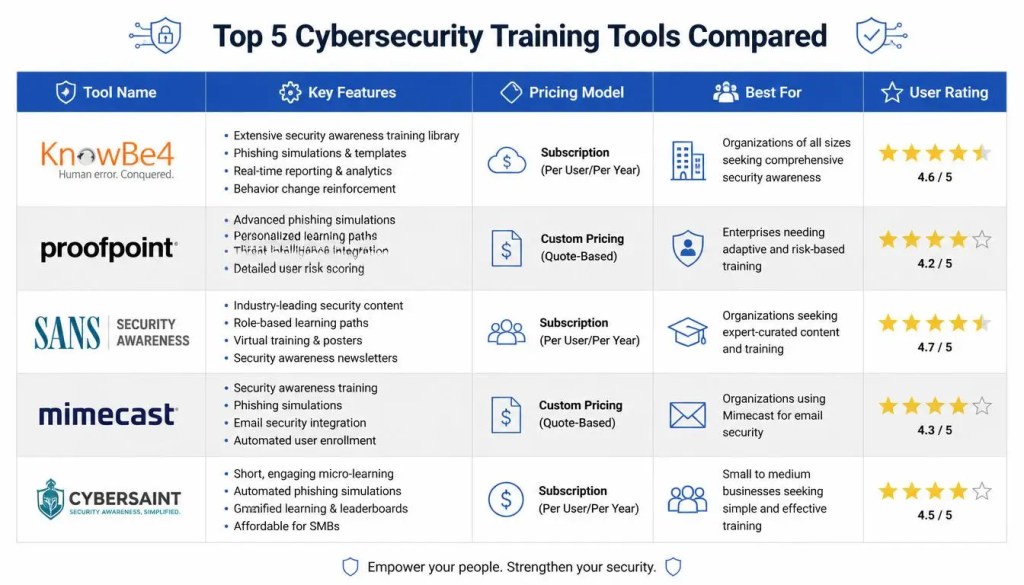
📌 Tools & Resources
❓ What are the best free resources for building a cyber-aware culture?
Here’s a curated list of free tools and frameworks to get started:
Resource | Provider | What It Offers | Best For |
NCSC (UK) | Free cyber incident simulation tool (e.g., phishing, ransomware) | Testing incident response | |
CISA (US) | Posters, videos, toolkits, and training materials | General awareness campaigns | |
NCSC (UK) | Baseline security certification (includes training and policy templates) | UK SMEs, compliance | |
NIST (US) | Guidelines for managing cybersecurity risk | Risk assessment, policy development | |
OWASP | Free courses on web security, phishing, and more | Developers, IT teams | |
Cybrary | Beginner to advanced cybersecurity courses | All employees | |
Interactive quiz to test phishing awareness | Quick self-assessment | ||
ENISA (EU) | Best practices for building security awareness | EU organisations | |
ICO (UK) | Guidance on data protection and compliance | GDPR training | |
Cofense | Free phishing simulation for up to 500 users | Small businesses |
Pro Tip: Start with 1–2 free resources (e.g., NCSC’s Exercise in a Box + Google’s Phishing Quiz) to test and refine your approach before investing in paid tools.
❓ What are the best paid tools for cybersecurity awareness training?
If you have a budget, these paid tools can scale and automate your cyber-aware culture efforts:
Tool | Provider | Key Features | Best For | Pricing | Link |
KnowBe4 | KnowBe4 | Phishing simulations, training modules, security awareness programs | All-sized organisations | Custom (starts at ~$10/user/year) | |
Proofpoint Security Awareness | Proofpoint | AI-driven training, personalised risk scoring, phishing simulations | Enterprise, high-risk industries | Custom | |
Mimecast Awareness Training | Mimecast | Email security training, compliance-focused content | Compliance-heavy industries (e.g., finance, healthcare) | Custom | |
SANS Securing The Human | SANS | Gamified, role-based training with certifications | Technical and non-technical teams | Custom | |
Infosec IQ | Infosec | Customisable training, phishing simulations, compliance tracking | Mid-sized to large organisations | Custom | |
TalentLMS | TalentLMS | Cloud-based LMS for cybersecurity training | Scalable training for all employees | Starts at $69/month | |
Docebo | Docebo | AI-powered LMS with gamification | Enterprise learning | Custom | |
Cofense PhishMe | Cofense | Advanced phishing simulations, reporting tools | High-risk industries (e.g., banking, government) | Custom | |
Barracuda PhishLine | Barracuda | Phishing simulations, training, and reporting | SMEs and enterprises | Custom | |
Darktrace Antigena | Darktrace | AI-driven behavioural analytics + training | Predictive threat detection | Custom |
Pro Tip: Many tools offer free trials or demos, so test a few to see which best fits your needs.
❓ How do I choose the right cybersecurity training tool for my organisation?
Step 1: Assess Your Needs
- What are your biggest risks? (e.g., phishing, ransomware, insider threats)
- Who needs training? (e.g., all employees, specific departments, executives)
- What’s your budget? (e.g., free, <£5K/year, >£50K/year)
- What’s your company size? (e.g., <50 employees, 50–500, 500+)
Step 2: Compare Features
Feature | Why It Matters | Tools That Offer It |
Phishing Simulations | Tests and improves vigilance | KnowBe4, Proofpoint, Mimecast, Cofense |
Customisable Training | Tailor content to your industry/roles | SANS, Infosec IQ, TalentLMS |
Gamification | Increases engagement | KnowBe4, SANS, Docebo |
Compliance Tracking | Meets GDPR, ISO 27001, etc. | Proofpoint, Mimecast, Infosec IQ |
AI/Behavioural Analytics | Personalises training based on risk | Proofpoint, Darktrace |
Mobile-Friendly | Accessible for remote/hybrid workers | TalentLMS, Docebo, KnowBe4 |
Multi-Language Support | For global teams | KnowBe4, Proofpoint, SANS |
Reporting & Analytics | Track progress and ROI | All major tools |
Step 3: Test Before Committing
- Sign up for free trials (e.g., KnowBe4’s Free Phishing Test).
- Run a pilot with a small group (e.g., IT team or high-risk department).
- Gather feedback from employees on usability and effectiveness.
Step 4: Consider Scalability
- Can the tool grow with your organisation? (e.g., add more users, modules, or integrations)
- Does it integrate with your existing systems? (e.g., HR software, LMS, email platforms)
📌 Legal & Compliance
❓ How does a cyber-aware culture help with GDPR compliance?
A cyber-aware culture directly supports GDPR compliance by:
Reducing Human Error
- GDPR fines often result from employee mistakes (e.g., mishandling data, falling for phishing).
- Example: A £500K GDPR fine was issued to a UK company after an employee emailed sensitive data to the wrong recipient (ICO, 2023).
Improving Data Protection Practices
- Training ensures employees:
- Understand data classification (e.g., personal vs. sensitive data).
- Follow secure data handling (e.g., encryption, access controls).
- Report breaches quickly (GDPR requires 72-hour breach notification).
Demonstrating Due Diligence
- GDPR Article 32 requires appropriate security measures, including staff awareness training.
- Documented training programs can reduce fines by showing proactive compliance efforts.
Enhancing Incident Response
- Employees trained in breach detection can report incidents faster, helping meet GDPR’s 72-hour rule.
Key GDPR Requirements Addressed by Training:
GDPR Article | Requirement | How Training Helps |
Article 5 | Lawfulness, fairness, transparency | Employees understand how to handle data ethically. |
Article 25 | Data Protection by Design | Staff integrate security into processes. |
Article 32 | Security of Processing | Training on passwords, encryption, phishing meets this. |
Article 33 | Breach Notification | Employees know how/when to report incidents. |
Article 39 | DPO (Data Protection Officer) Tasks | Training supports DPO efforts to educate staff. |
Pro Tip: Document all training (e.g., attendance, quiz scores, phishing test results) to prove compliance in case of an audit.
❓ What are the legal consequences of poor cybersecurity awareness?
Answer: Severe and growing. Poor cybersecurity awareness can lead to:
Regulatory Fines
- GDPR: Up to £17.5M or 4% of global revenue (whichever is higher).
- Example: British Airways (2020) – £20M fine for a breach caused by poor security practices (ICO).
- UK Data Protection Act 2018: Similar penalties to GDPR.
- NIS2 Directive (EU): Fines up to €10M or 2% of global turnover for critical infrastructure sectors (e.g., energy, transport, healthcare).
- PCI DSS: £5K–£100K/month for non-compliance (if handling payment data).
Legal Liability
- Customers or partners may sue for damages after a breach.
- Example: Equifax (2017) paid $700M in fines and settlements after a breach affecting 147M people.
Reputational Damage
- 75% of consumers stop doing business with a company after a breach (om: Data Privacy & Brand Trust Statistics 2026).
- Example: TalkTalk (2015) lost £60M in revenue and 100K customers after a breach.
Operational Downtime
- Average downtime per breach: 22 days (Ponemon, 2023).
- Example: Maersk (2017) lost $300M due to NotPetya ransomware (caused by one unpatched server).
Insurance Issues
- Cyber insurance claims may be denied if negligence is proven (e.g., no employee training).
- Example: A UK SME’s claim was rejected after a breach because they hadn’t trained staff on phishing (BIBA, 2023).
How to Mitigate Legal Risks:
✅ Document all training (e.g., attendance, quiz results, phishing test scores).
✅ Align training with regulations (e.g., GDPR, NIS2, PCI DSS).
✅ Conduct regular audits (e.g., check if employees follow policies).
✅ Appoint a DPO (Data Protection Officer) if required by GDPR.
❓ How do I ensure my cybersecurity training meets compliance standards?
Step 1: Identify Applicable Regulations Common frameworks and laws that require cybersecurity training:
- GDPR (EU/UK) – Article 32 (Security of Processing) mandates staff awareness training.
- NIS2 Directive (EU) – Requires incident reporting training for critical infrastructure sectors.
- UK Data Protection Act 2018 – Aligns with GDPR training requirements.
- PCI DSS (Payment Card Industry) – Requirement 12.6 mandates security awareness training for all employees.
- ISO 27001 – Clause A.7.2.2 requires information security awareness, education, and training.
- HIPAA (US, but relevant for UK firms handling US healthcare data) – Security Rule §164.308(a)(5) requires security awareness training.
Step 2: Map Training to Compliance Requirements
Regulation | Training Requirement | How to Comply |
GDPR | All staff must understand data protection principles | Annual GDPR training, role-specific modules (e.g., HR, finance). |
NIS2 | Incident reporting training for critical sectors | Simulated incident response drills, clear reporting procedures. |
PCI DSS | All employees must receive security awareness training | Annual PCI DSS training, phishing simulations, password hygiene. |
ISO 27001 | Ongoing security awareness for all staff | Regular training, phishing tests, documented completion records. |
HIPAA | Workforce must be trained on security policies | Annual HIPAA training, role-based modules (e.g., healthcare staff). |
Step 3: Document Everything
- Training records (e.g., who completed what, when, and their scores).
- Phishing test results (e.g., failure rates, improvements over time).
- Incident reports (e.g., how quickly employees report suspicious activity).
- Policy acknowledgments (e.g., signed documents confirming employees read and understood policies).
Step 4: Use Compliance-Focused Training Tools
- GDPR/ISO 27001: Mimecast, Proofpoint
- PCI DSS: KnowBe4 (offers PCI DSS-specific modules)
- NIS2: SANS Securing The Human (includes incident response training)
Step 5: Audit Regularly
- Conduct internal audits (e.g., quarterly reviews of training records).
- Hire a third-party auditor (e.g., for ISO 27001 or PCI DSS certification).
- Use compliance management tools (e.g., OneTrust, Drata).
- Example: A UK financial services company ensured GDPR and PCI DSS compliance by:
- Mapping training modules to GDPR Article 32 and PCI DSS Requirement 12.6.
- Documenting all training in a centralised LMS (TalentLMS).
- Running quarterly audits to verify 100% completion rates.
- Hiring an external auditor to certify PCI DSS compliance.
- Result: Passed all regulatory audits and reduced breach risk by 70%.
❓ What are some common cybersecurity mistakes employees make and how can training prevent them?
Here are the top 10 employee mistakes and how training can fix them:
Mistake | Risk | How Training Helps | Training Example |
Clicking phishing links | Malware, credential theft, ransomware | Teaches how to spot phishing emails (e.g., mismatched URLs, urgent language). | Phishing simulations + instant feedback |
Reusing passwords | Credential stuffing attacks | Promotes unique passwords + password managers. | “Password Hygiene 101” workshop |
Not using MFA | Account takeovers | Explains why MFA is critical and how to enable it. | Hands-on MFA setup training |
Falling for social engineering | Fraud, data breaches | Trains employees to verify identities (e.g., call back on a known number). | Role-playing exercises (e.g., fake IT support calls) |
Ignoring software updates | Exploitable vulnerabilities | Emphasises why updates matter and how to enable auto-updates. | “Patch Management Best Practices” module |
Using unsecured Wi-Fi | Man-in-the-middle attacks | Teaches how to secure home networks and use VPNs. | “Remote Work Security” guide |
Sharing sensitive data insecurely | Data leaks, compliance violations | Covers secure file sharing (e.g., encrypted emails, approved cloud storage). | “GDPR & Data Handling” training |
Not reporting suspicious activity | Delayed incident response | Encourages a no-blame reporting culture. | “See Something, Say Something” campaign |
Plugging in unknown USBs | Malware, ransomware | Warns against using unfamiliar devices. | “USB Security” microlearning video |
Oversharing on social media | Social engineering, targeted attacks | Educates on what not to post (e.g., job titles, travel plans). | “Social Media Security” workshop |
- Pro Tip: Use real-world examples in training to make risks tangible. For example:
- Show a real phishing email that tricked an employee.
- Demonstrate how a weak password led to a breach (e.g., Colonial Pipeline).
📌 Future Trends & Emerging Threats
❓ What are the biggest cybersecurity threats to prepare employees for in 2026?
The cyber threat landscape is evolving at an unprecedented pace, driven by AI advancements, geopolitical tensions, and the growing complexity of digital ecosystems. Here are the top cybersecurity threats organisations should prioritise in training for 2026, backed by authoritative sources and real-world examples:
🔮 1. AI-Powered Cyberattacks
📌 Why It’s a Threat:
- AI lowers the barrier to entry for cybercriminals, enabling more sophisticated, automated, and personalised attacks at scale.
- Generative AI (e.g., ChatGPT, DeepMind) can craft highly convincing phishing emails, deepfake videos, and voice clones with minimal effort.
- AI-driven malware can adapt in real-time to evade detection.
🛡 How to Train Employees:
✅ Teach employees to spot AI-generated content (e.g., unnatural language patterns, slight distortions in deepfake audio/video).
✅ Reinforce the importance of verification (e.g., call back on a known number, use secondary authentication methods).
✅ Run AI-specific phishing simulations (e.g., deepfake CEO requests, AI-generated invoices).
📢 Real-World Example:
- 2025: A UK finance director transferred £200K after receiving a deepfake voice call from their “CEO” requesting an urgent payment. The audio was generated using AI voice-cloning tools (DCL Search: AI mimics CEO voice to cam UK energy firm).
- 2024: Cybercriminals used AI to generate hyper-personalised phishing emails, increasing click-through rates by 40% (ENISA Threat Landscape Report, 2025).
🔗 Further Reading:
🔮 2. Supply Chain Attacks
📌 Why It’s a Threat:
- Third-party vendors, software providers, and cloud services are increasingly targeted as entry points into larger organisations.
- Supply chain attacks surged by 179% in 2024 (Tech Passport 2025).
- One weak link in the supply chain can compromise hundreds of organisations (e.g., SolarWinds, Kaseya).
🛡 How to Train Employees:
✅ Educate procurement and IT teams on vendor risk assessment (e.g., security audits, contractual obligations).
✅ Train employees to recognise supply chain red flags (e.g., unexpected software updates, unusual requests from vendors).
✅ Implement “zero trust” principles for third-party access (e.g., least privilege, multi-factor authentication).
📢 Real-World Example:
- 2024: SolarWinds 2.0 – Hackers compromised a widely used HR software provider, affecting 500+ companies across Europe and the US. The attack went undetected for 6 months (CRN).
- 2023: 3CX Supply Chain Attack – A Trojanised version of the 3CX desktop app was used to infect downstream customers (com: 3CX Supply Chain Attack affects thousands).
🔗 Further Reading:
🔮 3. Ransomware-as-a-Service (RaaS) & Double Extortion
📌 Why It’s a Threat:
- RaaS kits are sold on the dark web, making it easy for low-skilled attackers to launch ransomware attacks.
- Double extortion (stealing data and encrypting it) is now the norm, with an increasing proportion of ransomware attacks involving data theft (ScienceDirect: Deception in double extortion ransomware attacks).
- Ransomware attacks increased by 93% in 2024 (Tech Passport 2025).
🛡 How to Train Employees:
✅ Teach employees to recognise ransomware red flags (e.g., locked files, unusual pop-ups, slow systems).
✅ Train on incident response (e.g., immediately disconnect infected devices, report to IT).
✅ Reinforce backup and recovery procedures (e.g., regular backups, offline storage).
📢 Real-World Example:
- 2026: A UK hospital chain was hit by a RaaS attack, leading to 3 weeks of downtime and £10M in recovery costs. The attackers stole patient data and encrypted systems, demanding a £5M ransom (Industrial Cyber: Healthcare ransomware attacks remain resilient).
- 2025: The Clop ransomware gang exploited a zero-day vulnerability in MOVEit Transfer, affecting thousands of organisations worldwide (BleepingComputer, Clop ransomware likely testing MOVEit zero-day since 2021).
🔗 Further Reading:
🔮 4. IoT & Smart Device Exploits
📌 Why It’s a Threat:
- The number of IoT devices is expected to reach 29 billion by 2026 (IoT Insider: Global IoT connections set to reach 21.9 billion by 2026).
- Many IoT devices lack basic security (e.g., default passwords, unpatched firmware).
- Hackers can use IoT devices as entry points into corporate networks (e.g., smart cameras, printers, HVAC systems).
🛡 How to Train Employees:
✅ Educate on securing IoT devices (e.g., change default passwords, enable encryption, segment networks).
✅ Train IT teams on IoT risk management (e.g., device inventory, patch management).
✅ Raise awareness of physical security risks (e.g., unsecured USB ports, devices left unattended).
📢 Real-World Example:
- 2025: A hacker accessed a company’s smart office system through an unsecured IP camera and stole sensitive meeting data from conference rooms (The Times (paywall): How hackers target smart offices).
- 2024: A UK manufacturer’s production line was shut down after hackers exploited a vulnerable industrial IoT sensor (Arctic Wolf: Top 10 Manufacturing Industry Cyber Attacks).
🔗 Further Reading:
🔮 5. Business Email Compromise (BEC) 2.0
📌 Why It’s a Threat:
- According to FBI data, BEC attacks cost businesses £2.5 billion in 2024
- AI is making BEC more convincing (e.g., deepfake emails, fake legal documents, AI-generated signatures).
- Attackers are targeting non-financial departments (g., HR, legal, procurement) to bypass financial controls.
🛡 How to Train Employees:
✅ Train finance, HR, and procurement teams on verifying payment requests (e.g., call-back procedures, multi-person approvals).
✅ Teach employees to spot advanced BEC tactics (e.g., AI-generated emails, fake vendor invoices, urgent requests).
✅ Implement “out-of-band verification” (e.g., require a phone call or in-person confirmation for large transactions).
📢 Real-World Example:
- 2026: A UK law firm lost £1.2M after a fake client email (generated with AI) requested a fund transfer to a new account. The solicitor failed to verify the request via phone (UK Finance Annual Fraud Report 2026).
- 2024: A US tech company’s CFO approved a $25M transfer after receiving a deepfake video call from their “CEO” (AI Incident Database).
🔗 Further Reading:
🔮 6. Deepfake Social Engineering
📌 Why It’s a Threat:
- Deepfake technology is becoming indistinguishable from reality (e.g., AI-generated videos, voice clones, and images).
- Many cybersecurity professionals believe deepfakes will be used in successful attacks by 2026 (Adaptive Security: AI Deepfake in 2026).
- Attackers use deepfakes to impersonate executives, customers, or IT support to trick employees into transferring funds or sharing credentials.
🛡 How to Train Employees:
✅ Educate on deepfake detection (e.g., unnatural blinking, lip sync errors, background distortions).
✅ Implement verification protocols (e.g., require a secondary authentication method for high-risk requests).
✅ Run deepfake awareness simulations (e.g., fake CEO video calls, AI-generated voice messages).
📢 Real-World Example:
- 2025: A UK energy company’s CEO was impersonated in a deepfake video call, tricking an employee into transferring £250K to a fraudulent account (DCL Search: AI mimics CEO voice to scam UK energy firm).
- 2024: A Spanish bank’s employee was tricked by a deepfake voice call from their “manager,” leading to a €1M fraudulent transfer (Forbes: A voice deepfake was used to scam a CEO).
🔗 Further Reading:
🔮 7. Cloud Misconfigurations & Shadow IT
📌 Why It’s a Threat:
- 90% of organisations use multiple cloud services, increasing the risk of misconfigurations and shadow IT (unapproved cloud apps).
- 31% of cloud breaches are caused by misconfigurations (CrowdStrike).
- Shadow IT (e.g., unapproved SaaS tools, personal cloud storage) can expose sensitive data to cybercriminals.
🛡 How to Train Employees:
✅ Train IT and DevOps teams on cloud security best practices (e.g., least privilege access, encryption, regular audits).
✅ Educate employees on the risks of shadow IT (e.g., unapproved cloud apps, personal devices).
✅ Implement a cloud governance policy (e.g., approved vendor list, data classification rules).
📢 Real-World Example:
- 2026: data from health firm ESHYFT, including more than 86,000 personal data records and exposed due to an unsecured AWS S3 bucket that was misconfigured by an employee (SC Magazine: Misconfigured AWS S3 bucket exposes US nurses’ data).
- 2024: A US healthcare provider suffered a breach after an employee used a personal Google Drive account to store patient data (HIPAA Journal, 2024).
🔗 Further Reading:
🔮 8. Insider Threats (Coerced, Malicious & Accidental)
📌 Why It’s a Threat:
- Insider threats (both malicious and accidental) account for 34% of breaches (Verizon DBIR, 2026).
- Malicious insiders (e.g., disgruntled employees, contractors) can steal data or introduce malware.
- Accidental insiders (e.g., employees who click phishing links, mishandle data) are just as dangerous.
🛡 How to Train Employees:
✅ Implement insider threat training (e.g., data handling policies, offboarding procedures).
✅ Train managers on spotting risky behaviour (e.g., unusual access patterns, data exfiltration attempts).
✅ Encourage a “see something, say something” culture (e.g., anonymous reporting channels).
📢 Real-World Example:
- Tesla 2023: A former employee was charged with planting malicious code in Tesla’s manufacturing operating system, intending to cause significant financial and operational damage. The attack was discovered before it could be triggered, but it highlighted the risks of insider threats in critical infrastructure.
- UK Financial Services (2024): A disgruntled employee at a UK financial services firmleaked sensitive customer data to a third party, resulting in a £500,000 fine from the UK’s Financial Conduct Authority (FCA) and severe reputational harm. The incident underscored the financial and regulatory risks of insider threats.
🔗 Further Reading:
🔮 9. 5G & Remote Work Exploits
📌 Why It’s a Threat:
- 5G networks introduce new vulnerabilities (e.g., network slicing, edge computing risks).
- Remote work expands the attack surface (e.g., unsecured home networks, personal devices, public Wi-Fi).
- Hackers are targeting remote workers with phishing, VPN exploits, and device theft.
🛡 How to Train Employees:
✅ Train remote workers on secure connectivity (e.g., VPNs, MFA, device encryption).
✅ Educate on the risks of public Wi-Fi (e.g., man-in-the-middle attacks, eavesdropping).
✅ Implement a “remote work security policy” (e.g., approved devices, secure home network requirements).
📢 Real-World Example:
- 2026: A hacker intercepted unencrypted video calls from a remote executive team by exploiting a vulnerability in their home router (Wired UK, 2026).
- 2025: A UK employee’s laptop was stolen from a café, leading toa data breach of 50,000 customer records because the device lacked full-disk encryption (BBC News, 2025).
🔗 Further Reading:
🔮 10. Quantum Computing
📌 Why It’s a Threat:
- Quantum computers will break current encryption (e.g., RSA, ECC) within the next 5–10 years.
- Nation-state actors and cybercriminals are already preparing for a “post-quantum” world.
- Sensitive data encrypted today (e.g., health records, financial data) will be decryptable in the future by quantum computers.
🛡 How to Train Employees:
✅ Raise awareness of quantum computing risks (e.g., long-term data protection).
✅ Train IT teams on post-quantum cryptography (e.g., lattice-based encryption, hash-based signatures).
✅ Encourage the adoption of quantum-resistant algorithms (e.g., NIST’s Post-Quantum Cryptography Standards).
📢 Real-World Example:
- 2025: NIST finalised its Post-Quantum Cryptography Standards, urging organisations to begin transitioning to quantum-resistant algorithms.
- 2024: A UK government agency began piloting quantum-resistant encryption for highly sensitive communications (NCSC, 2024).
🔗 Further Reading:
❓ How can I future-proof my cyber-aware culture?
The cyber threat landscape is constantly evolving, but these strategies will help your organisation stay ahead:
🔹 1. Adopt a “Security-First” Mindset
- Embed security into every decision (e.g., new projects, vendor selections, employee onboarding).
- Make security a core value (e.g., include it in your company’s mission statement).
- Example: Microsoft’s “Secure by Design” approach ensures security is considered at every stage of product development.
📌 Action Items:
✅ Include security in job descriptions (e.g., “All employees are responsible for cybersecurity”).
✅ Add security goals to performance reviews (e.g., “Demonstrates cybersecurity awareness”).
✅ Host quarterly “Security First” town halls to reinforce the message.
🔹 2. Leverage AI for Personalised Training
- Use AI-driven platforms (e.g., Proofpoint’s Human Risk Management, Darktrace) to:
- Identify high-risk employees (e.g., those who repeatedly click phishing links).
- Deliver customised training based on individual risk profiles.
- Automate phishing simulations and adapt them in real-time.
📌 Action Items:
✅ Pilot an AI-driven training tool (e.g., Proofpoint, KnowBe4).
✅ Use behavioural analytics to identify and address knowledge gaps.
✅ Automate training assignments based on employee roles and risk levels.
🔹 3. Run Advanced Simulations & Red Team Exercises
- Test employees with realistic, evolving threats (e.g., AI phishing, deepfake social engineering).
- Conduct “Red Team vs. Blue Team” exercises to simulate real-world cyberattacks.
📌 Action Items:
✅ Run quarterly advanced phishing simulations (e.g., AI-generated emails, deepfake voice calls).
✅ Host annual tabletop exercises for incident response (e.g., ransomware, supply chain attacks).
✅ Partner with cybersecurity firms (e.g., Mandiant, CrowdStrike) for realistic red team exercises.
📢 Example:
Barclays runs quarterly “Cyber War Games” where employees face simulated attacks (e.g., deepfake CEO requests, ransomware scenarios). Result: 90% of employees can now identify and report advanced threats.
🔹 4. Foster a Culture of Continuous Learning
Cybersecurity is not a “set it and forget it” effort—it requires ongoing education and adaptation.
📌 Action Items:
✅ Implement microlearning (e.g., 5-minute weekly security tips).
✅ Encourage employees to earn certifications (e.g., CISSP, CompTIA Security+, NCSC Certified Training).
✅ Host monthly “Security Book Clubs” or webinars with industry experts.
📢 Example:
Google offers free cybersecurity training to all employees, including gamified modules and certifications. Result: <0.1% phishing click rate, one of the lowest in the industry (Google Security Blog, 2025).
🔹 5. Collaborate with Industry Peers & Authorities
- Share threat intelligence with trusted partners, industry groups, and government agencies.
- Participate in cybersecurity communities (e.g., CIISec, ISACA, SASIG).
📌 Action Items:
✅ Join a threat intelligence sharing group (e.g., NCSC’s ACD, FS-ISAC for financial services).
✅ Attend cybersecurity conferences (e.g., InfoSecurity Europe, Black Hat, DEF CON).
✅ Partner with local universities for cybersecurity research and training.
📢 Example:
The NCSC’s Active Cyber Defence initiative allows organisations to share real-time threat intelligence with government and industry peers and access a range of related services. Members report 50% faster incident detection (NCSC, 2026).
🔹 6. Prepare for Post-Quantum Cryptography
Quantum computing is on the horizon, and organisations must start preparing now.
📌 Action Items:
✅ Audit current encryption methods (e.g., RSA, ECC) for quantum vulnerability.
✅ Pilot post-quantum cryptography (e.g., NIST-approved algorithms like CRYSTALS-Kyber).
✅ Train IT teams on quantum-resistant security (e.g., lattice-based encryption).
📢 Example:
The UK Government has mandated post-quantum cryptography for all critical national infrastructure by 2028 (NCSC, 2025).
🔹 7. Focus on Psychological Safety & Employee Wellbeing
- Stressed or overworked employees are more likely to make mistakes (e.g., clicking phishing links, ignoring security protocols).
- A positive security culture reduces human error and increases vigilance.
📌 Action Items:
✅ Promote work-life balance (e.g., flexible hours, mental health support).
✅ Encourage a “no-blame” reporting culture (e.g., reward employees for reporting mistakes).
✅ Train managers on the link between wellbeing and security (e.g., “How stress affects cybersecurity decisions”).
📢 Example:
Salesforce found that employees who took regular breaks were 40% less likely to click on phishing links (Lyra Health Case Study: Salesforce). They now include mental health resources in their cybersecurity training programs.
🔹 8. Implement Zero Trust Architecture
- Zero Trust assumes that no user or device is trustworthy by default, even if they’re inside the network.
- 60% of organisations are adopting Zero Trust to combat insider threats and advanced attacks (Gartner, 2026).
📌 Action Items:
✅ Adopt the principle of “never trust, always verify” (e.g., MFA for all access, least privilege rules).
✅ Implement continuous authentication (e.g., behavioural biometrics, device posture checks).
✅ Train employees on Zero Trust principles (e.g., “Why you need to re-authenticate even on the company network“).
📢 Example:
Microsoft implemented Zero Trust across its entire organisation, resulting in a 70% reduction in successful phishing attacks(Microsoft Security Blog, 2025).
❓ What are the key skills employees will need in 2026 and beyond?
As cyber threats evolve, so must employee skills. Here are the top cybersecurity skills to prioritise in training:
Skill | Why It Matters | How to Train | Relevant Roles |
Phishing & Social Engineering Awareness | 90% of breaches start with phishing (Verizon DBIR, 2025). | Simulated phishing tests, microlearning modules | All employees |
AI & Deepfake Detection | AI-powered attacks are rising (e.g., deepfake emails, voice clones). | Workshops on spotting AI-generated content | All employees, especially executives |
Multi-Factor Authentication (MFA) Management | MFA blocks 99.9% of account takeovers (Microsoft, 2025). | Hands-on MFA setup training | All employees |
Secure Remote Work Practices | Hybrid work increases risks (e.g., unsecured Wi-Fi, device theft). | Training on VPNs, home network security, device encryption | Remote/hybrid employees |
Data Protection & GDPR Compliance | Non-compliance can result in fines up to 4% of global revenue. | GDPR training, data handling best practices | HR, finance, legal, all employees |
Incident Reporting & Response | Early detection reduces breach impact. | Tabletop exercises, incident response drills | All employees, especially IT and security teams |
Cloud Security & Misconfiguration Prevention | 63% of cloud breaches are due to misconfigurations (IBM, Cost of a Data Breach Report 2026). | Cloud security training, least privilege access | IT, DevOps, cloud administrators |
Supply Chain Risk Management | Supply chain attacks surged by 179% in 2024. | Vendor risk assessment training, secure procurement practices | Procurement, IT, finance |
Insider Threat Awareness | 34% of breaches involve insiders (Verizon DBIR, 2026). | Insider threat training, data handling policies | All employees, managers |
Zero Trust Principles | Zero Trust reduces breach risk by 60% (Gartner, 2026). | Zero Trust workshops, continuous authentication training | IT, security teams, all employees |
Pro Tip: Tailor training to roles, for example, finance teams need BEC and fraud awareness, while IT teams need advanced threat detection and incident response.
📌 1. Follow Authoritative Sources
Subscribe to newsletters, reports, and alerts from trusted organisations:
Source | What It Offers | Frequency | Link |
NCSC Weekly Threat Report | Latest cyber threats, vulnerabilities, and mitigation advice | Weekly | |
ENISA Threat LandscapeReport | Annual overview of emerging cyber threats in the EU | Annual | |
CISA Alerts & Advisories | Real-time alerts on critical vulnerabilities and threats | As needed | |
Krebs on Security | In-depth analysis of cybercrime trends and breaches | Daily/Weekly | |
The Hacker News | Latest cybersecurity news, breaches, and vulnerabilities | Daily | |
BleepingComputer | Breaking news on cyberattacks, malware, and vulnerabilities | Daily | |
Dark Reading | Expert insights, threat intelligence, and best practices | Daily |
Pro Tip: Set up Google Alerts for keywords like “cybersecurity threats 2026,” “new phishing trends,” “ransomware news” to get real-time updates.
📌 2. Join Cybersecurity Communities
Engage with professional networks and forums to share knowledge and stay informed:
Community | What It Offers | How to Join |
UK-based cybersecurity community with events, training, and networking | Membership (free and paid options) | |
UK-based networking group of over 5,000 senior cybersecurity professionals, running regular in-person and virtual events | Free | |
Global cybersecurity and IT governance community | Membership | |
Resources, tools, and community for web security | Free | |
UK threat intelligence sharing community | Free for UK organisations | |
FS-ISAC (Financial Services Information Sharing and Analysis Centre) | Threat intelligence sharing for financial services | Membership |
Discussions, news, and Q&A on cybersecurity topics | Free | |
Networking, job opportunities, and industry discussions | Free |
📌 3. Attend Cybersecurity Conferences & Webinars
Participate in industry events to learn from experts and network with peers:
Event | Focus | When/Where |
Cybersecurity trends, solutions, and networking | June, London (Hybrid) | |
Cutting-edge research, vulnerabilities, and exploits | December, London | |
Annual partner showcase for members to meet the organisations who fund SASIG | September, London | |
Hacking, Cyber security research and hands-on workshops | August, Las Vegas (Hybrid | |
NCSC’s flagship cybersecurity conference | May, UK (Hybrid | |
Strategic cybersecurity insights for leaders | June/September, Global | |
Cybersecurity innovation, trends, and best practices | April/May, San Francisco (Hybrid) | |
Community-driven cybersecurity talks and workshops | Global, Year-round | |
Free and paid training on emerging threats | Online, Year-round |
Pro Tip: Many conferences offer free or discounted virtual passes—take advantage of these to stay updated without travel costs.
📌 4. Partner with Cybersecurity Vendors & Experts
Work with trusted vendors and consultants to access cutting-edge threat intelligence – obviously this is not an exhaustive list, just some examples of the types of organisation you might want to consider:
Vendor/Expert | What They Offer | How to Engage |
Threat intelligence, incident response, and training | Consulting, reports, webinars | |
Endpoint protection, threat intelligence, and training | Free resources, demos, consulting | |
Advanced threat intelligence and cybersecurity solutions | Reports, webinars, consulting | |
Human-centric cybersecurity, phishing simulations, and training | Free trials, reports, webinars | |
Security awareness training, phishing simulations | Free trials, resources, webinars | |
AI-driven cybersecurity, threat detection, and response | Free demos, reports, webinars |
Pro Tip: Many vendors offer free threat intelligence reports—sign up for their newsletters and alerts.
📌 5. Use Threat Intelligence Platforms
Leverage threat intelligence platforms to stay ahead of emerging risks– as above, obviously this is not an exhaustive list, just some examples of the types of organisation you might want to consider:
Platform | What It Offers | Best For |
Open-source threat intelligence sharing | IT and security teams | |
Collaborative threat intelligence | SMEs and enterprises | |
Real-time threat intelligence and analysis | Enterprises, MSSPs | |
AI-driven threat intelligence | Enterprises, government | |
Threat intelligence platform with automation | Enterprises, security teams |
Pro Tip: Integrate threat intelligence feeds into your SIEM (Security Information and Event Management) system to automate threat detection and response.
❓ What’s the future of cybersecurity awareness training?
The future of cybersecurity awareness training is personalised, immersive, and data-driven. Here’s what’s next:
🔹 1. Hyper-Personalised Training with AI
- AI will analyse employee behaviour (e.g., phishing test results, login patterns, role-specific risks) to deliver customised training modules.
- Example: An employee who fails a phishing test might automatically receive a targeted module on spotting AI-generated emails.
📌 Tools to Watch:
🔹 2. Immersive Training with VR & AR
- Virtual Reality (VR) and Augmented Reality (AR) will enable hands-on, interactive training (e.g., simulated cyberattacks, deepfake detection exercises).
- Example: Employees can practice responding to a ransomware attack in a virtual office environment.
📌 Tools to Watch:
- CyberStart (SANS) (Gamified cybersecurity training)
- Immersive Labs (VR-based cybersecurity simulations)
- Strive VR (Custom VR training for enterprises)
🔹 3. Gamification & Microlearning
- Gamification (e.g., leaderboards, badges, rewards) will increase engagement and retention.
- Microlearning (e.g., 5–10 minute modules) will fit into busy schedules and reinforce knowledge.
📌 Tools to Watch:
🔹 4. Behavioural Science & Nudge Theory
- Nudge theory (e.g., subtle prompts, social proof, loss aversion) will be used to influence secure behaviour.
- Example:
- Default settings: Enable MFA by default for all accounts.
- Social proof: “90% of your colleagues use a password manager—join them!”
- Loss aversion: “Not using MFA? You’re 5x more likely to be hacked.”
📌 Tools to Watch:
- Nudge Security (Behavioural analytics for security)
- Proofpoint’s Human Risk Management (Nudge-based training)
- RedFlags (Human risk management platform)
🔹 5. Continuous Authentication & Zero Trust
- Zero Trust will become the standard, with continuous authentication (e.g., behavioural biometrics, device posture checks).
- Example: Employees may need to re-authenticate every time they access sensitive data or change networks.
📌 Tools to Watch:
- Okta (Zero Trust identity management)
- Ping Identity (Continuous authentication)
- Microsoft Entra ID (Zero Trust security)
🔹 6. Employee Wellbeing & Cybersecurity
- Organisations will link cybersecurity to employee wellbeing, recognising that stressed or overworked employees are more vulnerable to mistakes.
- Example: Mental health resources, flexible work policies, and workload management will be integrated into cybersecurity programs.
📌 Tools to Watch:
- Headspace for Work (Mental health resources)
- BetterUp (Coaching for employee wellbeing)
🔹 7. Collaboration with AI & Automation
- AI will automate threat detection and response, allowing security teams to focus on strategic initiatives.
- Example: AI-driven chatbots will answer employee security questions in real-time, while automated phishing simulations will adapt to evolving threats.
📌 Tools to Watch:
- Darktrace Antigena (AI-driven threat detection)
- SentinelOne (Autonomous endpoint protection)
- Cisco Secure (AI-powered security)
📌 Final Thoughts: The Road Ahead for Cyber-Aware Cultures
The future of cyber-aware cultures is dynamic, human-centric, and technology-enabled. As threats evolve, so must our approaches to awareness, education, and training. Here’s a summary of the key takeaways for building a resilient, future-proof cyber-aware culture:
🔮 The Future of Cyber-Aware Cultures: Key Predictions for 2026–2030
Trend | Impact on Cyber-Aware Cultures | How to Prepare |
AI-Powered Attacks | More sophisticated phishing, deepfakes, and automated threats will emerge. | Train employees on AI detection (e.g., spotting deepfakes, verifying identities). Use AI-driven training platforms to personalise learning. |
Quantum Computing | Current encryption methods (e.g., RSA, ECC) will become vulnerable. | Adopt post-quantum cryptography (e.g., NIST-approved algorithms). Train IT teams on quantum-resistant security. |
Supply Chain Attacks | Third-party vendors will remain a top attack vector. | Implement vendor risk assessments. Train procurement teams on secure vendor selection. |
Remote & Hybrid Work | Unsecured home networks and devices will increase risks. | Provide remote work security training (e.g., VPNs, MFA, device encryption). Enforce Zero Trust principles. |
Regulatory Complexity | New laws (e.g., NIS2, GDPR updates) will require stricter compliance. | Stay updated on regulatory changes. Align training with compliance requirements (e.g., GDPR, ISO 27001). |
Insider Threats | Malicious and accidental insider threats will rise. | Implement insider threat training. Encourage a “see something, say something” culture. |
Ransomware & RaaS | Ransomware attacks will become more frequent and sophisticated. | Train employees on ransomware detection and response. Conduct regular backup and recovery drills. |
IoT & Smart Device Risks | Unsecured IoT devices will be targeted for network access. | Educate employees on IoT security best practices. Implement network segmentation for IoT devices. |
Behavioural Analytics | AI will analyse employee behaviour to detect anomalies. | Use behavioural analytics tools (e.g., Darktrace, Varonis) to identify high-risk employees. Provide targeted training based on risk profiles. |
Psychological Safety | Employees will need to feel safe reporting mistakes. | Foster a no-blame culture. Reward employees for reporting suspicious activity. |
🎯 Your 2026-7 Cyber-Aware Culture Action Plan
Use this 12-month roadmap to build, strengthen, or future-proof your cyber-aware culture:
📅 Q1: Assess & Plan
Task | Owner | Tools/Resources | Success Metric |
Run a baseline phishing test | IT/HR | Initial phishing failure rate | |
Survey employees on cybersecurity awareness | HR | % of employees who feel confident in spotting threats | |
Identify high-risk departments (e.g., finance, HR, IT) | CISO/Risk | Internal risk assessment | List of priority training groups |
Secure leadership buy-in | CISO/HR | Executive approval for budget/resources | |
Review and update cybersecurity policies | CISO/Legal | Updated policies aligned with 2026 threats |
📅 Q2: Launch Awareness & Training
Task | Owner | Tools/Resources | Success Metric |
Deploy AI-powered phishing simulations | IT/HR | Phishing failure rate <5% | |
Roll out role-based training modules | HR/IT | Training completion rate >90% | |
Host a “Cybersecurity Kick-off” event | CISO/HR | Internal comms (email, Slack, Teams) | Employee engagement (e.g., event attendance, quiz participation) |
Set up a #security-first Slack/Teams channel | IT/HR | Microsoft Teams, Slack | Number of active participants |
Launch a “Security Champions” program | CISO/HR | Internal nominations | Number of trained champions per department |
📅 Q3: Reinforce & Measure
Task | Owner | Tools/Resources | Success Metric |
Run quarterly phishing simulations | IT/HR | Phishing failure rate <3% | |
Conduct a tabletop exercise for ransomware response | CISO/IT | Incident response time <1 hour | |
Gather employee feedback on training | HR | >80% positive feedback | |
Review and update training content | CISO/HR | Internal review | Training modules updated for 2026 threats |
Recognise top performers (e.g., “Security Star of the Quarter”) | HR | Internal awards program | Increased reporting of suspicious activity |
📅 Q4: Future-Proof & Scale
Task | Owner | Tools/Resources | Success Metric |
Pilot an AI-driven training platform | CISO/HR | Personalised training assignments for high-risk employees | |
Run a deepfake awareness workshop | CISO/HR | 100% of executives trained on deepfake detection | |
Implement Zero Trust principles | IT | MFA adoption rate = 100% | |
Join a threat intelligence sharing group | CISO/IT | Active participation in threat sharing | |
Plan 2027 cybersecurity budget and strategy | CISO/HR | Internal review | Approved budget for 2027 initiatives |
🚀 Final Call to Action: Build Your Cyber-Aware Culture Today
The cyber threat landscape is evolving faster than ever, but a strong cyber-aware culture is your best defence. Whether you’re just starting or refining an existing program, the key is to act now, before the next breach happens.
🔹 Start small, but start today:
- Run a free phishing test (KnowBe4).
- Host a 30-minute “Cybersecurity 101” workshop for your team.
- Send a security tip email to all employees.
🔹 Scale with technology:
- Invest in an LMS (e.g., TalentLMS).
- Deploy AI-driven training (e.g., Proofpoint).
- Automate phishing simulations (e.g., KnowBe4).
🔹 Foster a culture of vigilance:
- Reward employees who spot and report threats.
- Encourage open discussions about cybersecurity risks.
- Make security a shared responsibility – from the CEO to the newest intern.
💡 Remember: Cybersecurity is a Team Sport
No single tool, policy, or person can fully protect your organisation. A cyber-aware culture is built on three pillars:
- Awareness – Keeping security top of mind (e.g., posters, emails, town halls).
- Education – Teaching foundational knowledge (e.g., workshops, e-learning).
- Training – Providing hands-on practice (e.g., phishing simulations, incident response drills).
When these pillars work together, you create a workforce that doesn’t just know about cybersecurity, they live it.
🌍 Together, We Can Build a Safer Digital Future
Cybersecurity isn’t just about protecting data, it’s about protecting people, reputations, and livelihoods. By investing in a cyber-aware culture today, you’re not just reducing risks, you’re empowering your team, strengthening your organisation, and contributing to a safer digital world.
The time to act is now. Are you ready to build your cyber-aware culture?
📚 Further Reading & Resources (more here)
Dive deeper into cyber-aware cultures with these authoritative resources:
📌 Reports & Guides
- NCSC’s Annual Review 2025 – UK cyber threat trends and best practices.
- ENISA’s Threat Landscape Report 2025 – Emerging cyber threats in Europe.
- IBM Cost of a Data Breach Report 2026 – Financial and operational impact of breaches.
- Verizon Data Breach Investigations Reoprt 2026 – Real-world breach statistics and human error insights.
- Gartner’s Top Security and Risk Management Trends 2026 – Strategic insights for cybersecurity leaders.
📌 Free Tools & Training
- NCSC’s Exercise in a Box – Free cyber incident simulation tool.
- CISA’s Cybersecurity Awareness Program – Posters, videos, and toolkits.
- Google’s Phishing Quiz – Interactive quiz to test phishing awareness.
- Udemy’s OWASP Security Training – Free courses on web security.
- Cybrary’s Free Cybersecurity Courses – Beginner to advanced training.
📌Frameworks & Standards
- NIST Cybersecurity Framework – A risk-based approach to cybersecurity.
- ISO 27001 – International standard for information security management.
- GDPR Guidance (ICO) – Data protection best practices.
- NIS2 Directive – EU cybersecurity regulations for critical infrastructure.
📌 Communities & Networks
- CIISec (Chartered Institute of Information Security) – UK cybersecurity professional body.
- The Security Awareness Special Interest Group (SASIG) – UK networking group for senior cybersecurity professionals
- ISACA – Global IT governance and cybersecurity community.
- NCSC’s Active Cyber Defence – UK threat intelligence sharing.
- FS-ISAC (Financial Services Information Sharing and Analysis Centre) – Threat intelligence for financial services.
💬 Join the Conversation
We’d love to hear from you! Share your thoughts, experiences, or questions in the comments below:
- What’s the biggest cybersecurity challenge your organisation faces?
- Have you implemented a cyber-aware culture program? What worked (or didn’t)?
- What emerging threats are you most concerned about?
🚀 Let’s build a safer digital future together. 🚀
#CyberAwareCulture #CybersecurityTraining #HumanFirewall #SecurityFirst #FutureOfCybersecurity