
The Ultimate Zero Trust FAQ: 25 Questions Answered (2026–2027 Edition)
📌 Introduction to Zero Trust
What is Zero Trust Architecture (ZTA)?
Zero Trust Architecture (ZTA) is a cybersecurity model that eliminates implicit trust and instead continuously verifies every access request, regardless of where it originates. Unlike traditional perimeter-based security (e.g., firewalls, VPNs), Zero Trust operates on the principle: “Never trust, always verify.”
Core Components of Zero Trust
Explicit Verification: Every user, device, and application must authenticate and authorise before accessing resources. This approach uses multi-factor authentication (MFA), behavioural analytics, and device posture checks.
Least Privilege Access: Users and systems are granted only the minimum permissions necessary to perform their tasks, e.g. A marketing intern can access social media tools but not financial systems.
Assume Breach: Operates under the assumption that attackers are already inside the network and focuses on limiting damage using micro-segmentation, continuous monitoring, and automated response to contain threats.
Micro-Segmentation: Divides the network into small, isolated segments to prevent lateral movement, e.g. Payment systems are isolated from HR databases.
Continuous Monitoring: Real-time analysis of users, devices, and network traffic to detect and respond to anomalies, using tools such as SIEM (Splunk, IBM QRadar), EDR (CrowdStrike, SentinelOne), XDR (Microsoft Defender XDR).
Why Zero Trust Matters in 2026
- 82% of breaches involve stolen or compromised credentials (IBM Cost of a Data Breach Report 2025).
- AI-driven attacks are growing at 400% annually (Europol IOCTA 2026).
- Hybrid work and cloud migration have dissolved traditional network perimeters.
Expert Insight:
“Zero Trust isn’t about distrust, it’s about removing blind trust. The old model assumed that if you were inside the network, you were safe. Zero Trust says: ‘Prove it. Every time.’
Actionable Takeaway: Start with identity and access management (IAM) the foundation of Zero Trust. Use NIST SP 800-207 as your guide.
What is Zero Trust Network Access (ZTNA)?
Zero Trust Network Access (ZTNA) is a specific implementation of Zero Trust focused on secure remote access. Unlike traditional VPNs, which grant broad network access once authenticated, ZTNA connects users only to the specific applications they need, without exposing the underlying network.
How ZTNA Works
User requests access: a user attempts to access a cloud-based CRM system (e.g., salesforce).
Identity verification: the ZTNA gateway checks the user’s identity using multi-factor authentication (MFA) (e.g., password + biometric), device posture checks (e.g., up-to-date patches, encryption, antivirus) and contextual factors (e.g., location, time, behaviour).
Policy enforcement: A policy engine evaluates the request against predefined rules, such as “allow access only if the user is on a company-managed device” or “deny access if the device is in a high-risk country.”
Secure connection establishment: If approved, the user is granted encrypted, least-privilege access to the CRM system only not the entire network. The application remains hidden from the public internet (via software-defined perimeter).
Continuous monitoring: The session is monitored in real time for anomalies (e.g., unusual data downloads), if suspicious activity is detected, the system can terminate the session or prompt for re-authentication.
ZTNA vs. VPN: Key Differences
Feature | Traditional VPN | ZTNA |
Access Scope | Grants full network access. | Grants application-specific access only. |
Attack Surface | High (exposes entire network). | Low (only exposes approved apps). |
User Experience | Slow, cumbersome, frequent disconnects. | Fast, seamless, reliable. |
Security Model | Perimeter-based (trusts internal traffic). | Zero Trust (verifies every request). |
Scalability | Limited (hardware-dependent). | Highly scalable (cloud-native). |
Case Study
How a Retailer Replaced VPNs with ZTNA A global retailer (50,000 employees) replaced its VPNs with Zscaler Private Access in 2025. Results:
- 90% reduction in helpdesk tickets (no more VPN connectivity issues).
- Zero VPN-related breaches (previously 3 breaches/year).
- 50% faster remote access for employees.
“ZTNA is not just a VPN replacement, it’s a security upgrade. VPNs are like giving someone the keys to your entire house when they only need to use the kitchen. ZTNA gives them a key to the kitchen only, and takes it back if they start acting suspiciously.”
Actionable Takeaway: Replace VPNs with ZTNA for secure, fast, and scalable remote access. Start with Cloudflare One, Zscaler Private Access, or Tailscale.
Why is Zero Trust important in 2026?
In 2026, the cybersecurity landscape is more complex and dangerous than ever. Traditional security models (e.g., firewalls, VPNs) are no longer sufficient due to:
a. The Rise of AI-Driven Attacks
AI-powered phishing: Attackers use generative AI to craft hyper-personalised emails that bypass traditional filters, e.g. AI-driven phishing attacks increased by 300% in 2025 (FBI IC3 Report 2025).
Automated exploitation: AI can scan for vulnerabilities and exploit them in minutes, e.g. Deepfake voice attacks tricked employees into transferring millions (MITRE AI in Cybersecurity 2025).
b. The Death of the Network Perimeter
Hybrid work: 47% of employees now work remotely (Gartner 2025), accessing systems from unmanaged devices on unsecured networks.
Cloud migration: 60% of enterprise workloads run in the cloud (IDC 2025), dissolving traditional network boundaries.
c. Regulatory Pressures
UK: The Cyber Security and Resilience Bill (NIS2) explicitly recommends Zero Trust for critical infrastructure.
EU: The Cyber Resilience Act (2025) requires Zero Trust controls for digital products.
US: CISA’s Zero Trust Maturity Model (2026) mandates Zero Trust for federal agencies by 2027.
d. The Cost of Inaction
Average breach cost: £4.5 million (IBM Cost of a Data Breach Report 2025).
Ransomware costs: £5.2 million (including downtime and ransom payments) (Check Point State of Ransomware 2026).
Organisations using Zero Trust reduce breach costs by 40% (Forrester 2025)
e. Industry Adoption Trends
Gartner predicts that by 2028, 70% of enterprises will have adopted Zero Trust (up from 10% in 2020).
Forrester’s 2026 survey found that 63% of organisations are already implementing ZTNA.
“In 2026, Zero Trust isn’t just a best practice, it’s a necessity. The threat landscape has evolved beyond what traditional security can handle. Organisations that fail to adopt Zero Trust will be left vulnerable to AI-driven attacks, ransomware, and insider threats.”
Actionable Takeaway:
- Start with a Zero Trust readiness assessment (use NIST’s tool or CISA’s model).
- Prioritise high-impact areas (e.g., MFA, ZTNA, least privilege).
- Leverage cloud-based solutions to reduce costs and complexity.
🔍 Core Concepts and Principles
What are the core principles of Zero Trust?
Zero Trust is built on five foundational principles, each designed to eliminate implicit trust and minimise attack surfaces. These principles are not just technical, they represent a fundamental shift in cybersecurity philosophy.
a. Explicit Verification: Never Trust, Always Verify
Definition: Every user, device, and application must authenticate and authorise for every access request, regardless of location or network.
How It Works:
- Multi-Factor Authentication (MFA): Requires at least two forms of verification (e.g., password + biometric or hardware token). NCSC Guidance: “Passwords alone are not enough. MFA should be the default”.
- Continuous Authentication: Uses behavioural analytics and AI to re-authenticate users if their behaviour deviates from the norm. Example: If a user typically logs in from London at 9 AM but suddenly attempts access from Moscow at 3 AM, the system blocks or challenges the request.
- Device Posture Checks: Ensures devices meet security policies (e.g., up-to-date patches, encryption, antivirus) before granting access. Tool Example: Microsoft’s Conditional Access enforces device compliance in real time.
b. Least Privilege Access: Grant Minimal Permissions Necessarily
Definition: Users, devices, and applications are granted only the minimum permissions required to perform their tasks. Nothing more.
How It Works:
- Just-In-Time (JIT) Access: Grants temporary, time-bound permissions for specific tasks. Example: A contractor working on a project gets access only for the duration of the project and only to the files they need.
- Micro-Segmentation: Divides the network into small, isolated segments, preventing lateral movement, using tools such as VMware’s NSX enables granular segmentation of network traffic.
- Attribute-Based Access Control (ABAC): Dynamically adjusts permissions based on context (e.g., user role, device security, location, time), unlike Role-Based Access Control (RBAC), which grants static permissions, ABAC adapts in real time.
c. Assume Breach: Operate as If Attackers Are Already Inside
Definition: Assume breach is a mindset shift. Instead of focusing solely on preventing breaches, Zero Trust assumes that attackers have already compromised the network and focuses on limiting damage.
How It Works:
- Continuous Monitoring: Uses SIEM, EDR, and XDR to detect anomalies in real time, using tools such as CrowdStrike’s Falcon Platform uses AI-driven behavioural analysis to identify threats.
- Automated Response: Isolates compromised devices or revokes access in real time, e.g. If an endpoint exhibits ransomware-like behaviour, Zero Trust systems can automatically quarantine the device.
- Micro-Segmentation: Limits lateral movement by isolating critical systems.
d. Micro-Segmentation: Divide and Conquer
Definition: Micro-segmentation is the practice of dividing a network into small, isolated segments to limit lateral movement andcontain breaches.
How It Works:
- Network Isolation: Critical systems (e.g., databases, admin consoles) are separated from the rest of the network.
- Application Segmentation: Applications are isolated from each other, preventing attackers from moving between them.
- Workload Segmentation: Cloud workloads (e.g., containers, VMs) are protected individually.
e. Continuous Monitoring: Detect and Respond in Real Time
Definition: Continuous monitoring involves real-time analysis of users, devices, applications, and network traffic to detect and respond to threats as they occur.
How It Works:
- User and Entity Behaviour Analytics (UEBA): Uses machine learning to detect anomalous behaviour (e.g., a user accessing files at 3 AM when they usually work 9–5).
- Endpoint Detection and Response (EDR): Monitors endpoints (devices) for signs of compromise (e.g., unusual processes, malware, or data exfiltration).
- Security Information and Event Management (SIEM): Aggregates and analyses log data from across the network to identify patterns and threats.
- Extended Detection and Response (XDR): Combines EDR, network traffic analysis, and cloud security for holistic visibility.
How does Zero Trust differ from traditional security models?
Zero Trust represents a fundamental departure from traditional, perimeter-based security models. While traditional approaches rely on static defences (e.g., firewalls, VPNs), Zero Trust adopts a dynamic, identity-centric philosophy. Here’s a detailed breakdown of the key differences:
a. Security Philosophy: Trust vs. Verify
Why It Matters: Traditional models assume that anything inside the network perimeter is safe; a dangerous assumption in today’s cloud-first, hybrid-work world. Zero Trust eliminates this blind spot by requiring continuous verification for every access request, regardless of origin.
Example: In 2024, a major financial institution suffered a breach when attackers compromised a VPN and moved laterally across the network undetected for months. Had the institution used Zero Trust, micro-segmentation and continuous monitoring would have contained the attack to the initial entry point.
b. Access Control: Static vs. Dynamic
Why It Matters: Traditional RBAC grants fixed permissions based on job roles, which can lead to over-permissioned users (a top cause of breaches). Zero Trust’s ABAC adjusts permissions dynamically based on real-time context (e.g., device security, location, time of day).
Case Study: JPMorgan Chase reduced its attack surface by 60% after implementing least-privilege access and ABAC for its 150,000+ employees. The bank now automatically revokes access if a user’s behaviour or device posture changes.
c. Network Architecture: Perimeter vs. Segmentation
Why It Matters:
In traditional networks, one compromised device can lead to a full breach (e.g., NotPetya ransomware spread laterally across Maersk’s unsegmented network in 2017). Zero Trust’s micro-segmentation ensures that even if attackers breach one segment, they can’t access others.
“Traditional security is like a castle with a moat, once attackers breach the outer wall, they have free rein. Zero Trust is like a bank vault: every door requires a unique key, and cameras monitor everything.”
d. Threat Detection: Reactive vs. Proactive
Why It Matters: Traditional security relies on known threats (e.g., signature-based antivirus), which fails against zero-day attacks. Zero Trust’s continuous monitoring and AI-driven analytics detect unusual behaviour (e.g., a user accessing files at 3 AM) and automatically respond.
Data Point: Organisations using Zero Trust reduce breach detection time from 200+ days to under 1 hour (IBM Cost of a Data Breach Report 2025).
e. User Experience: Friction vs. Seamlessness
Why It Matters: Traditional VPNs are notoriously slow and unreliable, leading users to bypass security (e.g., 15% of employees admit to disabling VPNs for speed Forrester 2025). Zero Trust’s ZTNA provides faster, more reliable access without sacrificing security.
Actionable Takeaways:
- Replace firewalls/VPNs with ZTNA and micro-segmentation.
- Shift from RBAC to ABAC for dynamic, context-aware permissions.
- Adopt continuous monitoring with AI-driven analytics (e.g., UEBA, EDR/XDR).
- Improve UX with passwordless authentication and seamless ZTNA.
🚀 Implementation and Deployment
How do I get started with Zero Trust?
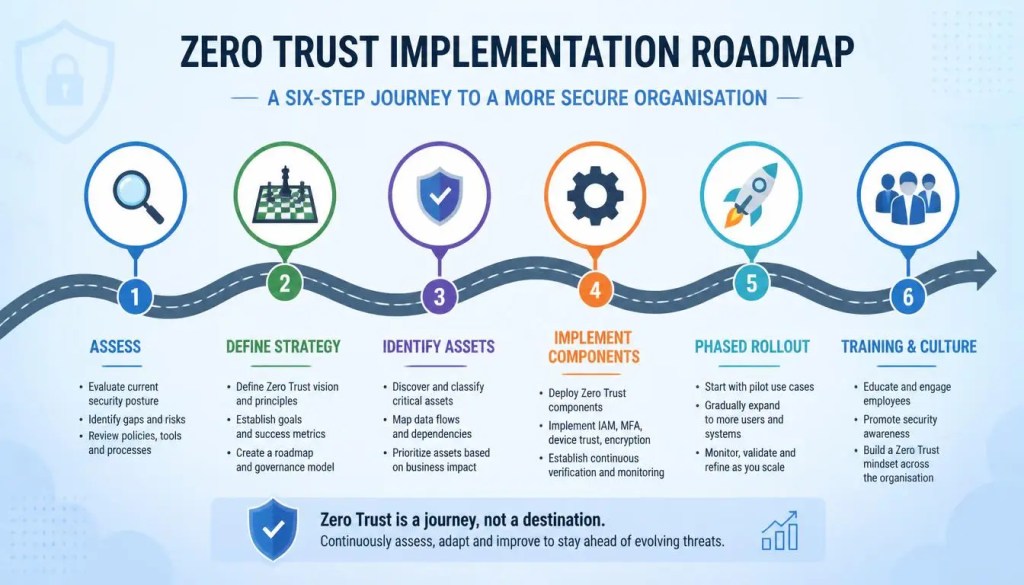
Implementing Zero Trust can feel overwhelming, but a phased, pragmatic approach makes it manageable. Here’s a step-by-step roadmap based on NIST SP 800-207 and CISA’s Zero Trust Maturity Model (2026):
Step 1: Assess Your Current Security Posture (1–3 Months): to identify gaps, risks, and dependencies in your existing security model.
“The biggest mistake organisations make is skipping the assessment phase. You can’t secure what you don’t understand. Map your attack surface first.”
Case Study: HSBC conducted a 6-month Zero Trust assessment before full deployment. They found:
- 40% of employees had unnecessary admin privileges.
- 25% of third-party vendors had no MFA enforcement.
- Legacy banking systems were not segmented from modern applications. Result: HSBC prioritised fixes before rolling out Zero Trust, reducing implementation time by 30%.
Step 2: Define Your Zero Trust Strategy (1–2 Months): to align Zero Trust with business goals, compliance requirements, and risk tolerance.
“Zero Trust isn’t a one-size-fits-all solution. Tailor your strategy to your organisation’s unique risks and priorities.”
Step 3: Implement Core Zero Trust Components (6–12 Months): to deploy the technical foundations of Zero Trust in phases.
- Identity and Access Management (IAM) to ensure only authorised users and devices can access resources.
- Zero Trust Network Access (ZTNA) to replace VPNs with secure, identity-centric remote access.
- Micro-Segmentation to isolate critical systems to prevent lateral movement.
- Continuous Monitoring and Response to detect and respond to threats in real time.
Step 4: Pilot and Scale (3–6 Months) to test Zero Trust in a controlled environment before full deployment.
“A phased rollout is critical for Zero Trust success. Start small, learn fast, and scale smart. Don’t try to boil the ocean.”
Step 5: Train and Optimise (Ongoing) to educate employees and continuously improve your Zero Trust implementation.
“Zero Trust isn’t just a technology change; it’s a culture change. The most successful implementations are led by executives, owned by IT, and embraced by every department.”
Case Study: A UK healthcare provider implemented a Zero Trust training program in 2024 after a phishing attack led to a data breach. The program included:
- Mandatory Zero Trust training for all staff.
- Monthly phishing simulations with personalised feedback.
- “Security Champions” in each department to promote best practices. Result: 70% reduction in successful phishing attacks in 2025 and 90% employee compliance with MFA and least privilege policies.
How long does it take to implement Zero Trust?
The timeline for implementing Zero Trust varies by organisation size, complexity, and existing infrastructure, but a typical phased rollout looks like this:
- Assess (1–3 months), involving a readiness assessment, gap analysis, data flow mapping NIST SP 800-207, CISA Maturity Model, Microsoft Zero Trust Assessment
- Plan (1–2 months), involving strategy development, policy framework, prioritise critical assets NIST Zero Trust Guidelines, Microsoft Zero Trust Framework
- Pilot (3–6 months): Test with a small user group, refine policies, gather feedback Okta, Zscaler Private Access, CrowdStrike Falcon
- Deploy: (6–12 months) Roll out IAM, ZTNA, micro-segmentation, continuous monitoring Microsoft Entra ID, VMware NSX, Splunk, CrowdStrike
- Optimise (Ongoing): Monitor for anomalies, automate incident response, conduct regular audits SIEM (Splunk, IBM QRadar), SOAR (Palo Alto XSOAR, Splunk Phantom)
“Most organisations take 12–24 months to fully implement Zero Trust. Start small, measure progress, and scalebased on lessons learned. The key is consistency and persistence.”
What are the biggest challenges in implementing Zero Trust, and how can I overcome them?
Implementing Zero Trust is not without challenges, but with the right strategy, these obstacles can be overcome. Here are the top 5 challenges and how to address them:
Challenge 1: Legacy System Integration
Why It’s Hard: Older systems (e.g., mainframes, unsupported software) may not support modern Zero Trust controls (e.g., MFA, micro-segmentation), e.g. A UK bank had a 30-year-old mainframe critical for payment processing but couldn’t modify itto support Zero Trust.
Solutions:
- Use ZTNA Overlays: A software layer that sits between users and legacy apps, enforcing Zero Trust policies without modifying the app itself. Users authenticate via ZTNA (e.g., Cloudflare One), which proxies the connection to the legacy app, e.g. The UK bank used Zscaler Private Access to secure its mainframe without changing the system.
- Micro-Segment Legacy Systems: Isolate legacy systems from the rest of the network to limit exposure. Use VMware NSX or Cisco ACI to create a segmented network zone for legacy apps, e.g. A manufacturing plant micro-segmented its legacy SCADA systems to prevent ransomware from spreading.
- Deploy Jump Servers (Bastion Hosts): A secure gateway that controls access to legacy systems. Users connect to the jump server first, which enforces MFA and least privilege before allowing access to legacy apps, e.g. A healthcare provider used jump servers to secure remote access to its legacy EHR system.
“Legacy systems are not a roadblock to Zero Trust; they’re a priority. The fact that they’re old doesn’t mean they’re not valuable, or not targeted. Isolate, monitor, and control access to them just like you would with modern systems.”
Challenge 2: User Resistance and Productivity Concerns
Why It’s Hard: Employees may resist changes (e.g., MFA, least privilege) if they perceive them as cumbersome or slowing them down, e.g. A tech company initially saw 15% of employees bypass VPNs due to slow performance.
Solutions:
- Improve the User Experience: Use seamless MFA (e.g., biometrics, push notifications). Adopt passwordless authentication (e.g., FIDO2, hardware tokens), e.g. Microsoft’s Windows Hello for Business allowspasswordless logins with biometrics or PINs.
- Communicate the Benefits: Explain how Zero Trust protects everyone (e.g., “MFA prevents 99.9% of account takeovers” Microsoft Security): Highlight productivity gains (e.g., faster remote access, fewer password resets).
- Pilot with Early Adopters: Start with tech-savvy teams (e.g., IT, engineering) who can provide feedback and champion the change, e.g. A SaaS company piloted Zero Trust with its IT team before rolling it out company-wide. The IT team provided feedback and helped refine the UX, leading to 95% user adoption.
“The key to user adoption is making security invisible. If your employees notice security, you’re doing it wrong. The goal is seamless, frictionless access that’s also highly secure.”
Challenge 3: Vendor Lock-In and Interoperability
Why It’s Hard: Proprietary Zero Trust solutions may lock you into a single vendor, making it hard to switch or integrate with other tools, e.g. A retailer initially adopted a single-vendor Zero Trust solution but later struggled to integrate it with its existing SIEM.
Solutions:
- Adopt Open Standards: Zero Trust standards (e.g., NIST SP 800-207, OpenZiti) ensure interoperability. Use API-driven tools for easy integration, e.g. OpenZiti is an open-source ZTNA framework that works with multiple vendors.
- Multi-Vendor Approach: Mix and match best-of-breed solutions (e.g., Okta for IAM, CrowdStrike for EDR, Cloudflare for ZTNA), e.g. A global retailer used Okta for IAM, Zscaler for ZTNA, and CrowdStrike for EDR to avoid vendor lock-in.
- Cloud-Agnostic Solutions: Avoid vendor-specific cloud services if you use multi-cloud environments, e.g. Cloudflare One works across AWS, Azure, and GCP.
“Vendor lock-in is a real risk in Zero Trust. Prioritise open standards and interoperability to avoid being tied to a single provider.”
Challenge 4: Cost and Complexity
Why It’s Hard: Zero Trust implementations can be complex and costly, especially for large organisations with legacy systems, e.g. A manufacturing company initially underestimated the cost of Zero Trust and struggled to secure budget approval.
Solutions:
- Start with High-Impact, Low-Cost Areas: Prioritise MFA, least privilege, and ZTNA (which offer immediate ROI), e.g. MFA can be implemented for free using Microsoft Authenticator or Google Authenticator.
- Leverage Managed Services: Outsource Zero Trust to MSSPs (Managed Security Service Providers) if in-house expertise is lacking, e.g. Accenture’s Zero Trust Services can handle implementation, monitoring, and optimisation for you.
- Use Cloud-Based Solutions: Cloud-native Zero Trust tools (e.g., Microsoft Defender for Cloud, AWS Zero Trust) reduce hardware and maintenance costs, e.g. Cloudflare One starts at £5/user/month, making it affordable for SMEs.
Data Point:
- Organisations that implement Zero Trust reduce breach costs by 40% (IBM Cost of a Data Breach Report 2026).
- ROI of Zero Trust: 300–500% over 3–5 years (Forrester Total Economic Impact of Zero Trust 2025).
“The question isn’t ‘Can we afford Zero Trust?’ It’s ‘Can we afford NOT to?’ The cost of a breach dwarfs the cost of prevention.”
Challenge 5: Compliance and Regulatory Alignment
Why It’s Hard: Zero Trust must align with industry regulations (e.g., GDPR, NIS2, HIPAA, PCI DSS), e.g. A healthcare provider struggled to map Zero Trust controls to HIPAA requirements.
Solutions:
Map Zero Trust to Compliance Requirements:
- GDPR: Zero Trust helps with data protection, access controls, and audit logging.
- NIS2 (EU): Mandates Zero Trust for critical infrastructure by 2026.
- PCI DSS: Requires least privilege, MFA, and segmentation.
- HIPAA: Zero Trust supports access controls, encryption, and monitoring.
Use Compliance-Ready Tools:
- ZTNA solutions (e.g., Zscaler, Cloudflare) often include compliance reporting.
- SIEM tools (e.g., Splunk, IBM QRadar) can generate audit logs for regulators.
Work with Compliance Experts:
- Engage legal and compliance teams to ensure Zero Trust aligns with regulations.
- Example: A UK bank worked with Deloitte’s compliance team to map Zero Trust to NIS2 and GDPR.
🔧 Technical Details
What is the difference between Zero Trust and Zero Trust Network Access (ZTNA)?
While Zero Trust Architecture (ZTA) and Zero Trust Network Access (ZTNA) are closely related, they serve distinct purposes within a modern cybersecurity framework. Here’s a detailed breakdown:
Zero Trust Architecture (ZTA): The Big Picture
Definition: ZTA is a holistic security model that applies the principles of Zero Trust across an entire organisation. It encompasses:
- Users (identity verification, MFA, least privilege).
- Devices (posture checks, compliance, encryption).
- Applications (micro-segmentation, access controls).
- Data (encryption, DLP, classification).
- Networks (segmentation, continuous monitoring).
Key Principles:
- Never trust, always verify (explicit verification for every access request).
- Least privilege access (grant minimal permissions necessary).
- Assume breach (operate as if attackers are already inside).
Example: Google’s BeyondCorp is a ZTA implementation that eliminates network-based trust and verifies every access request based on user identity and device posture.
Zero Trust Network Access (ZTNA): A Specific Implementation
Definition: ZTNA is a specific application of Zero Trust focused exclusively on secure remote access. It replaces traditional VPNs by:
- Granting access to applications, not networks.
- Verifying identity and context before allowing access.
- Hiding applications from the public internet (via Software-Defined Perimeter (SDP)).
How ZTNA Fits into ZTA
ZTNA is a critical component of ZTA, but it doesn’t replace the broader Zero Trust model. Instead, it complements it by ensuring that remote access is as secure as internal access. Think of it this way:
- ZTA = The entire security philosophy (e.g., a healthy lifestyle).
- ZTNA = One key practice within that philosophy (e.g., exercising regularly).
“ZTNA is the most visible part of Zero Trust because it directly impacts users, but it’s just one piece of the puzzle. ZTA is the full framework that ensures end-to-end security.”
Actionable Takeaway:
- Start with ZTNA if your primary goal is secure remote access.
- Adopt ZTA for a holistic security transformation.
- Integrate ZTNA into your ZTA strategy to ensure consistent security policies across all access points.

How does micro-segmentation work in Zero Trust?
Micro-segmentation is a cornerstone of Zero Trust, designed to limit lateral movement and contain breaches by dividing a network into small, isolated segments. Here’s how it works in practice:
Micro-segmentation is the process of creating granular, isolated zones within a network to:
- Prevent attackers from moving laterally (e.g., from a compromised workstation to a database).
- Reduce the attack surface by limiting exposure of critical systems.
- Improve visibility and control over network traffic.
Example: In a traditional flat network, if an attacker breaches a single workstation, they can move freely across the network to access databases, file servers, or admin consoles. With micro-segmentation, the attacker is confined to the isolated segmentwhere the breach occurred.
Benefits of Micro-Segmentation
✅ Reduces Lateral Movement: 70% of ransomware attacks involve lateral movement. Micro-segmentation stops this in its tracks (Gartner 2025).
✅ Limits Attack Surface: Isolates critical systems from less sensitive ones.
✅ Improves Compliance: Helps meet GDPR, HIPAA, and PCI DSS requirements for data isolation.
✅ Enables Zero Trust: A key component of a full Zero Trust Architecture.
“In 2026, 78% of ransomware attacks involve lateral movement. Micro-segmentation cuts this risk dramatically by containing attackers to a single segment.”
Challenges and Solutions
- Complexity: Start with high-risk systems (e.g., databases, payment systems) and expand gradually.
- Legacy Systems: Use ZTNA overlays (e.g., Cloudflare One) to secure legacy apps without modifying them.
- Performance Impact: Use hardware-accelerated segmentation (e.g., VMware NSX with NIC offloading) to minimise latency.
- Visibility Gaps: Deploy network traffic analysis (NTA) tools (e.g., Darktrace, Vectra) to monitor inter-segment traffic.
Actionable Takeaway:
- Start with critical systems (e.g., databases, payment systems, admin consoles).
- Use SDN tools (e.g., VMware NSX, Cisco ACI) to implement micro-segmentation.
- Combine with continuous monitoring (e.g., SIEM, EDR) to detect and contain threats.
- Automate incident response to isolate compromised segments quickly.
What is continuous authentication, and how does it work in Zero Trust?
Continuous authentication is a core principle of Zero Trust that goes beyond traditional one-time login checks. Instead of verifying a user’s identity only at the start of a session, continuous authentication repeatedly confirms identity and trustworthiness throughout the session based on behavioural and contextual signals.
Continuous authentication dynamically assesses risk throughout a user’s session using multiple signals:
- Behavioural Biometrics
- Device Posture
- Contextual Factors
- Adaptive Access Controls
Benefits of Continuous Authentication
✅ Stops Session Hijacking: Detects and blocks attackers who steal session tokens.
✅ Prevents Insider Threats: Identifies unusual behaviour from legitimate users (e.g., a disgruntled employee accessing sensitive data).
✅ Adapts to AI-Powered Attacks: Detects deepfake phishing, credential stuffing, and other advanced threats.
✅ Improves User Experience: Reduces unnecessary re-authentication for low-risk sessions.
“Continuous authentication is the future of identity security. Traditional MFA is no longer enough; attackers are bypassing it with AI and social engineering. Continuous authentication adds a layer of dynamic, behavioural-based security that’s nearly impossible to spoof.”
Challenges and Solutions
- Privacy Concerns: Use anonymised behavioural data and comply with GDPR/CCPA.
- False Positives: Tune algorithms with machine learning to reduce false alerts.
- Performance Overhead: Use lightweight agents (e.g., BioCatch’s browser-based authentication).
- Legacy Systems: Deploy proxy-based continuous authentication (e.g., Cloudflare One with adaptive MFA).
Actionable Takeaway:
- Start with high-risk systems (e.g., admin consoles, financial systems).
- Use behavioural biometrics (e.g., BioCatch, TypingDNA) for dynamic authentication.
- Combine with device posture checks (e.g., Microsoft Intune, CrowdStrike) to assess risk holistically.
- Implement adaptive access controls to step up authentication when risk increases.
How does Zero Trust help with compliance (e.g., GDPR, NIS2, HIPAA)?
Zero Trust directly supports compliance with global regulations by enforcing strict access controls, monitoring, and audit capabilities. Below is a detailed breakdown of how Zero Trust aligns with key compliance frameworks in 2026:
GDPR (General Data Protection Regulation) requirement to protect personal data (PII) and ensure lawful, fair, and transparent processing.
“GDPR isn’t just about data protection, it’s about accountability. Zero Trust provides the audit trails, access controls, and encryption needed to prove compliance.”
NIS2 Directive (EU) Requirement: Critical infrastructure (e.g., energy, transport, healthcare) must implement risk management measures to prevent and mitigate cyber threats.
“NIS2 explicitly recommends Zero Trust for critical infrastructure. Organisations that ignore this will face fines, legal action, or worse a catastrophic breach.”
HIPAA (Health Insurance Portability and Accountability Act) Requirement: Protect electronic Protected Health Information (ePHI) and ensure confidentiality, integrity, and availability.
“HIPAA requires strict access controls and audit logging—two areas where Zero Trust excels. It’s not just about preventing breaches; it’s about proving you did everything possible to stop them.”
PCI DSS (Payment Card Industry Data Security Standard) Requirement: Protect cardholder data and ensure secure payment processing.
“PCI DSS is all about segmentation and access controls—two areas where Zero Trust shines. If you’re handling payment data, Zero Trust isn’t optional; it’s essential.”
ISO 27001 (Information Security Management) Requirement: Establish, implement, maintain, and continuously improve an Information Security Management System (ISMS).
Can Zero Trust prevent ransomware attacks?
Yes. But not entirely on its own. Zero Trust dramatically reduces the risk and impact of ransomware by limiting attackers’ ability to move laterally, encrypt data, or exfiltrate information. However, no security model is 100% foolproof. Here’s how Zero Trust mitigates ransomware at every stage of the attack chain:
The Ransomware Attack Chain and How Zero Trust Stops It
Ransomware attacks typically follow 5 stages. Zero Trust disrupts each one:
Attack Stage | Traditional SecurityWeakness | How Zero Trust Mitigates It | Tools/Example |
1. Initial Access (e.g., phishing, exploited vulnerability) | Weak authentication(e.g., passwords only) | MFA + Continuous Authenticationblocks stolen credentials. | Okta, Microsoft Entra ID, BioCatch |
2. Execution (e.g., malware delivery) | No behaviour monitoring | EDR/XDR detects and blocks malicious processes. | CrowdStrike Falcon, SentinelOne |
3. Lateral Movement (e.g., spreading across network) | Flat networks allow free movement | Micro-segmentation isolates systems, preventing spread. | VMware NSX, Cisco ACI |
4. Privilege Escalation (e.g., gaining admin rights) | Over-permissioned users | Least Privilege + JIT Access limits permissions. | SailPoint, Saviynt |
5. Encryption/Exfiltration (e.g., locking files, stealing data) | No real-time monitoring | Continuous Monitoring + Automated Response contains attacks. | Splunk, Darktrace, Palo Alto XSOAR |
Statistic: Organisations with Zero Trust reduce ransomware impact by 80% (Sophos The State of Ransomware 2025).
Why Zero Trust Is Effective Against Ransomware
- Stops Initial Access: MFA and continuous authentication prevent attackers from using stolen credentials. Stat: 99.9% of account takeovers are blocked by MFA (Microsoft 2025).
- Limits Lateral Movement: Micro-segmentation ensures attackers can’t move freely across the network. Stat: 70% of ransomware attacks involve lateral movement—micro-segmentation stops this (Gartner 2025).
- Prevents Privilege Escalation: Least privilege + JIT access ensures attackers can’t gain admin rights even if they compromise an account. Stat: 80% of breaches involve excessive permissions (IBM 2025).
- Detects and Contains Attacks Early: Continuous monitoring + automated response stops ransomware before encryption.
Limitations of Zero Trust Against Ransomware
While Zero Trust greatly reduces ransomware risk, it’s not a silver bullet. Here’s what it cannot do alone:
❌ Prevent all phishing attacks (users can still be tricked into clicking malicious links), address this by developing a Cyber-Aware Culture through education, training and positive reinforcement.
❌ Stop zero-day exploits if systems are unpatched (though EDR/XDR can detect and block them), address this using EDR/XDR and relentless patch management.
❌ Protect against insider threats if malicious employees have legitimate access (though behavioural analytics can help), address this with user and entity behaviour analysis.
❌ Protect your backups from the effects of ransomware, address this using ransomware-resistant backup technologies.
“Zero Trust doesn’t make you ransomware-proof, but it makes you ransomware-resistant. Attackers will move on to easier targets if your systems are properly segmented, monitored, and controlled.”
Actionable Takeaway:
- Start with MFA and micro-segmentation, the two most effective ransomware defences.
- Combine Zero Trust with EDR/XDR and backups for layered protection.
- Train employees to recognise and report phishing attempts.
How does Zero Trust handle insider threats?
Insider threats, whether malicious employees, negligent users, or compromised accounts, are among the most difficult cyber risks to detect and mitigate. Traditional security models struggle with insider threats because they assume internal trust. Zero Trust, however, treats every user as a potential risk, making it far more effective at stopping insider threats.
Types of Insider Threats and How Zero Trust Mitigates Them
Type | Description | Example | How Zero Trust Mitigates It |
Malicious Insider | An employee intentionally steals data or sabotages systems. | A disgruntled IT admin deletes critical databases. | Least privilege + JIT access limits permissions. Continuous monitoring detects unusual activity (e.g., large data downloads). |
Negligent Insider | An employee accidentally causes a breach (e.g., clicks on phishing links, misconfigures systems). | A finance employee falls for a phishing email and exposes credentials. | MFA + continuous authentication prevents credential misuse. Micro-segmentation limits lateral movement. |
Compromised Account | An attacker gains control of a legitimate user’s account (e.g., via phishing or credential stuffing). | A hacker uses stolen admin credentials to access sensitive systems. | Behavioural analytics (UEBA) detects anomalies (e.g., a user accessing systems at 3 AM). Automated response revokes access if suspicious activity is detected. |
Third-Party Insider | A contractor, vendor, or partner with legitimate access misuses or leaks data. | A supplier exfiltrates customer data from a shared portal. | ZTNA + least privilege restricts third-party access to only necessary systems. Device posture checks ensure only compliant devices connect. |
How Zero Trust Detects and Prevents Insider Threats
Explicit Verification for Every Access Request: No implicit trust: Even if a user is already inside the network, they must re-authenticate for sensitive actions, e.g. A finance employee trying to access payroll data must re-enter MFA if their session has been idle.
Least Privilege Access: Minimum necessary permissions: Users only get access to what they need, nothing more using Just-In-Time (JIT) Access: Temporary permissions are granted only when required (e.g., for a specific task or time window), e.g. a contract developer gets access to a code repository for 24 hours—then it’s automatically revoked.
Continuous Monitoring and Behavioural Analytics (UEBA): Baseline normal behaviour: AI-driven tools (e.g., Exabeam, Varonis) learn how users typically interact with systems, detect anomalies, flags unusual activity, such as a non-admin usersuddenly accessing admin consoles, a user downloading 10x more data than usual or a user logging in from multiple countriesin a short time, e.g. a healthcare provider used Varonis UEBA to detect a nurse accessing patient records outside their department—a potential HIPAA violation.
Micro-Segmentation: Isolate sensitive systems: Prevents insiders from moving laterally to access data they shouldn’t, e.g. a bankmicro-segmented its payment systems from HR databases, so even if an HR employee’s account was compromised, attackers couldn’t access financial data.
Automated Incident Response: Real-time actions: If an anomaly is detected, the system can lock the account, revoke access, isolate the device. and alert security teams, e.g. a global retailer used Palo Alto XSOAR to automatically revoke access when a contractor’s account showed unusual activity.
“Insider threats are the hardest to detect because they look like normal activity—until they don’t. Zero Trust removes the blind spots by verifying every action, monitoring every user, and limiting every permission.”
👥 User Experience and Adoption
15. Will employees resist Zero Trust, and how can I encourage adoption?
Employee resistance is a common concern when implementing Zero Trust, but it’s not inevitable. In fact, properly implemented Zero Trust can improve the user experience by replacing clunky, outdated security tools (e.g., VPNs) with modern, seamless alternatives (e.g., ZTNA). Here’s how to minimise resistance and maximise adoption:
Why Employees Resist Security Changes
Reason for Resistance | Example | How Zero Trust Fixes It |
Friction | “I have to enter MFA every time I log in.” | Adaptive MFA (e.g., no prompts for trusted devices/locations). |
Slow Performance | “The VPN is always disconnecting.” | ZTNA (e.g., Cloudflare One, Zscaler Private Access) provides faster, more reliable access. |
Complexity | “I don’t understand why I can’t access this file.” | Clear communication + context-aware access policies (e.g., “You can’t access this because your device isn’t compliant.”). |
Lack of Awareness | “I don’t see the point of these security measures.” | Training on how Zero Trust protects them (e.g., “This stops phishing attacks that could steal your identity.”). |
Fear of Change | “I’m used to the old way.” | Pilot with early adopters (e.g., IT team) to gather feedback and refine the UX. |
Common Misconceptions That Fuel Resistance (And How to Address Them)
Misconception | Reality | How to Address It |
“Zero Trust will slow me down.” | ZTNA is faster than VPNs, and adaptive MFA reduces friction. | Demo the speed difference between VPNs and ZTNA. |
“I’ll have to remember more passwords.” | Passwordless authentication eliminates passwords entirely. | Show how FIDO2 or biometrics work. |
“This is just IT being controlling.” | Zero Trust protects you from cyberattacks that could disrupt your work or steal your data. | Share real-world examples of breaches that could have been prevented. |
“I don’t need this—I’m careful.” | Even careful users can fall for phishing or have their credentials stolen. | Run phishing simulations to demonstrate the risk. |
“This is too complicated.” | Zero Trust is designed to be simpler than traditional security (e.g., no VPNs). | Provide step-by-step guides and training. |
“The key to user adoption is making security a shared responsibility. When employees understand the benefits, for themselves and the company, they’ll embrace Zero Trust, not resist it.”
Actionable Takeaway:
- Start with a pilot group to gather feedback and refine the UX.
- Communicate the benefits (security, productivity, and personal protection).
- Use adaptive authentication and ZTNA to minimise friction.
- Appoint Security Champions to promote adoption.
- Measure and reward adoption to encourage participation.
How does Zero Trust impact remote and hybrid work?
Zero Trust doesn’t just support remote and hybrid work, it enables and secures it in ways that traditional models simply cannot. The shift to remote and hybrid work (now adopted by 63% of organisations globally (McKinsey 2025) has exposed the flaws of perimeter-based security (e.g., VPNs, firewalls). Zero Trust replaces these outdated models with a modern, flexible, and secure approach that scales with your workforce.
How Zero Trust Enables Secure Remote and Hybrid Work
Zero Trust replaces the limitations of traditional security with modern, flexible, and secure solutions designed for remote and hybrid environments. Here’s how:
- ZTNA Replaces VPNs for Faster, More Secure Remote Access
- Identity-Centric Security for Hybrid Workforces
- Least Privilege Access for Flexible Work Environments
- Continuous Monitoring for Real-Time Threat Detection
- Micro-Segmentation for Hybrid Cloud Environments
- Device Posture Checks for Secure Hybrid Work
“Hybrid work is the new normal, and Zero Trust is the only security model that can secure it. Traditional VPNs and firewalls can’t keep up with the flexibility and scalability demands of modern workforces.”
🔮 Future of Zero Trust
What does the future of Zero Trust look like in 2026 and beyond?
The future of Zero Trust is shaped by emerging technologies, evolving threats, and regulatory pressures. By 2026–2030, Zero Trust will evolve from a security model into a comprehensive, AI-driven, and autonomous framework. Here’s what’s on the horizon:
a. AI-Driven Zero Trust: The Rise of Autonomous Security
Trend: AI will transform Zero Trust from a rule-based system into a dynamic, self-learning security framework. By 2026, 75% of organisations will use AI in their Zero Trust strategies (Gartner 2025).
“By 2030, if not before, AI will be the brain of Zero Trust– automating decisions that humans can’t make fast enough. The future is autonomous, self-healing security that adapts to threats in real time.”
b. Quantum-Resistant Zero Trust: Preparing for Post-Quantum Cryptography
Trend: The rise of quantum computing threatens to break traditional encryption (e.g., RSA, ECC). By 2030, quantum computers could crack today’s encryption standards, making Zero Trust’s cryptographic foundations vulnerable.
“Quantum computing is not a distant threat it’s a 5–10 year reality. Organisations must start preparing now by adopting post-quantum cryptography in their Zero Trust models.”
c. Zero Trust for IoT and OT (Operational Technology)
Trend: The proliferation of IoT devices (e.g., smart sensors, medical devices, industrial robots) and OT systems (e.g., SCADA, ICS) creates new attack surfaces. By 2026, 45% of OT organisations will adopt Zero Trust (SANS OT Security Survey 2025).
“OT and IoT are the next frontier for Zero Trust. Traditional security models can’t handle the scale and complexity of these environments. Zero Trust provides the visibility, control, and segmentation needed to secure them effectively.”
d. Zero Trust as a Service (ZTaaS): Democratising Zero Trust
Trend: Many organisations lack the expertise or resources to implement Zero Trust in-house. Zero Trust as a Service (ZTaaS)provides a fully managed, cloud-based solution that democratises Zero Trust for SMEs and enterprises alike.
“ZTaaS is democratising Zero Trust allowing SMEs and enterprises alike to benefit from enterprise-grade security without the complexity.”
e. Zero Trust and Sustainability: Reducing e-Waste and Energy Use
Trend: As organisations prioritise sustainability, Zero Trust can reduce e-waste and energy consumption by:
- Eliminating legacy hardware (e.g., VPN appliances, firewalls).
- Optimising cloud security (e.g., reducing over-provisioned resources).
- Enabling remote work (e.g., reducing office energy use).
“Zero Trust doesn’t just improve security, it improves sustainability. By right-sizing access and eliminating waste, organisations can cut their cloud carbon footprint by 20–30%.”
f. The Convergence of Zero Trust and Identity-First Security
Trend: By 2026, identity will be the new perimeter. Zero Trust is evolving into an identity-first security model, where user and device identity (not network location) determines access.
“In the future, identity will be the foundation of Zero Trust. The question won’t be ‘Where are you connecting from?’ but ‘Who are you, and can we trust your device?’“
What are the emerging threats that Zero Trust will need to address in 2026?
As cyber threats evolve, Zero Trust must adapt to counter new and emerging risks. Here are the top threats that Zero Trust will need to address in 2026 and beyond:
a. AI-Powered Cyberattacks
Threat: Attackers are increasingly using AI to:
- Automate phishing attacks (e.g., deepfake emails, voice cloning).
- Exploit zero-day vulnerabilities at machine speed.
- Evasion techniques (e.g., AI-generated malware that bypasses traditional defences).
“AI is the biggest game-changer in cybersecurity. Attackers are using it to automate and scale attacks, but defenders can use it to detect and stop threats in real time.”
Actionable Takeaway:
- Deploy AI-driven threat detection (e.g., Darktrace, CrowdStrike).
- Use continuous authentication to stop deepfake attacks.
- Leverage predictive analytics to anticipate and block adaptive malware.
b. Supply Chain Attacks
Threat: Attackers are increasingly targeting third-party vendors, suppliers, and service providers to gain access to larger organisations. 62% of breaches in 2025 involved a supply chain component (IBM Cost of a Data Breach Report 2025).
“Supply chain attacks are the new normal. Zero Trust removes the trust we place in third parties and verifies every access request, no matter where it comes from.”
Actionable Takeaway:
- Apply Zero Trust principles to third parties (e.g., MFA, least privilege, micro-segmentation).
- Monitor third-party access continuously (e.g., SIEM, UEBA).
- Use DLP to prevent data leaks from vendors.
c. Quantum Computing Threats
Threat: Quantum computers threaten to break traditional encryption (e.g., RSA, ECC), which secures much of today’s digital infrastructure. By 2030, quantum computers could crack today’s encryption standards, rendering Zero Trust’s cryptographic foundations vulnerable.
d. IoT and OT Exploits
Threat: The proliferation of IoT (Internet of Things) and OT (Operational Technology) devices (e.g., industrial control systems, medical devices, smart sensors) has created new attack surfaces. By 2026, 70% of organisations will have IoT/OT devices connected to their networks (Gartner 2025), and 45% of OT organisations will adopt Zero Trust (SANS OT Security Survey 2025).
“IoT and OT are the next frontier for cyberattacks. Traditional security models can’t handle the scale and complexity of these environments. Zero Trust provides the visibility, control, and segmentation needed to secure them effectively.”
Actionable Takeaway:
- Start with device authentication (e.g., FIDO2, certificate-based auth).
- Micro-segment OT networks to isolate critical systems.
- Deploy AI-driven monitoring (e.g., Nozomi, Claroty) for anomaly detection.
e. Deepfake Social Engineering
Threat: Deepfake technology (AI-generated audio, video, or text) is being used to impersonate executives, vendors, or colleagues in phishing and fraud attacks. By 2028, deepfake attacks will account for 20% of all social engineering incidents(FBI IC3 Report 2025).
“Deepfake attacks are the next evolution of social engineering. Traditional defences like email filters and MFAwon’t stop them. Continuous authentication and behavioural analytics are the only way to detect and block these attacks.”
Actionable Takeaway:
- Deploy continuous authentication (e.g., BioCatch, Microsoft Defender for Identity).
- Use liveness detection for high-risk transactions (e.g., wire transfers, access to admin systems).
- Train employees to recognise deepfake red flags (e.g., unnatural speech patterns, unusual requests).
f. Zero-Day Exploits
Threat: Zero-day vulnerabilities (unknown flaws in software/hardware) are increasingly exploited by attackers before vendors can release patches. In 2025, 60% of breaches involved zero-day exploits (Mandiant M-Trends 2025).
“Zero-day exploits are inevitable, but their impact isn’t. Zero Trust limits the blast radius of these attacks by segmenting networks, enforcing least privilege, and monitoring continuously.”
Actionable Takeaway:
- Replace VPNs with ZTNA to reduce exposure to zero-day exploits.
- Deploy EDR/XDR (e.g., CrowdStrike, SentinelOne) for real-time threat detection.
- Use micro-segmentation to contain exploits to isolated segments.
What are the top current Zero Trust trends
As we move rapidly towards 2027, Zero Trust is evolving rapidly to address new threats, technologies, and business needs. Here are the top 10 Zero Trust trends to watch, backed by expert insights, data, and real-world examples:
🔥 Trend 1: AI and Machine Learning Integration
Why It Matters: AI is transforming Zero Trust from a static, rule-based model into a dynamic, self-learning framework. By 2026, 75% of organisations will use AI in their Zero Trust strategies (Gartner 2025).
“AI is the biggest game-changer in Zero Trust. It’s not just about detecting threats faster, it’s about stopping them before they even start.”
Actionable Takeaway:
- Integrate AI-driven tools (e.g., Darktrace, CrowdStrike, Microsoft Defender) into your Zero Trust framework.
- Use predictive analytics to anticipate and block threats before they occur.
🔥 Trend 2: Post-Quantum Cryptography (PQC) Adoption
Why It Matters: Quantum computing threatens to break traditional encryption (e.g., RSA, ECC). By 2030, quantum computers could crack today’s encryption standards, making Zero Trust’s cryptographic foundations vulnerable.
Actionable Takeaway:
- Monitor NIST’s PQC standardisation efforts and plan for migration.
- Test PQC in non-production environments to identify compatibility issues.
- Work with vendors (e.g., Cloudflare, Microsoft, AWS) that are already integrating PQC.
🔥 Trend 3: Zero Trust for IoT and OT (Operational Technology)
Why It Matters: The proliferation of IoT and OT devices (e.g., industrial control systems, medical devices, smart sensors) creates new attack surfaces. By 2026, 45% of OT organisations will adopt Zero Trust (SANS OT Security Survey 2025).
Actionable Takeaway:
- Start with device authentication (e.g., FIDO2, certificate-based auth).
- Micro-segment OT networks to isolate critical systems.
🔥 Trend 4: Zero Trust as a Service (ZTaaS)
Why It Matters: Many organisations lack the expertise or resources to implement Zero Trust in-house. Zero Trust as a Service (ZTaaS) provides a fully managed, cloud-based solution that democratises Zero Trust for SMEs and enterprises alike.
“ZTaaS is democratising Zero Trust, allowing SMEs and enterprises alike to benefit from enterprise-grade security without the complexity.”
Actionable Takeaway:
- Consider ZTaaS if you lack in-house expertise or resources.
- Evaluate cloud providers (e.g., Microsoft, AWS, Google Cloud) for built-in Zero Trust services.
- Partner with an MSSP for end-to-end Zero Trust management.
🔥 Trend 5: Identity-First Zero Trust
Why It Matters: Identity is the new perimeter. Zero Trust is evolving into an identity-first security model, where user and device identity (not network location) determines access.
“In the future, identity will be the foundation of Zero Trust. The question won’t be “Where are you connecting from? but ‘Who are you, and can we trust your device?’”
Actionable Takeaway:
- Adopt a unified identity platform (e.g., Okta, Microsoft Entra ID).
- Deploy ITDR tools to detect and respond to identity-based threats.
- Move toward passwordless authentication to eliminate credential-based attacks.
🔥 Trend 6: Zero Trust and Sustainability
Why It Matters: As organisations prioritise sustainability, Zero Trust can reduce e-waste and energy consumption by:
- Eliminating legacy hardware (e.g., VPN appliances, firewalls).
- Optimising cloud security (e.g., reducing over-provisioned resources).
- Enabling remote work (e.g., reducing office energy use).
“Zero Trust doesn’t just improve security, it improves sustainability. By right-sizing access and eliminating waste, organisations can cut their cloud carbon footprint by 20–30%.”
Actionable Takeaway:
- Replace hardware-based security (e.g., VPNs, firewalls) with cloud-based Zero Trust solutions.
- Use dynamic access controls to reduce idle resource usage.
- Leverage Zero Trust to enable remote work and reduce office energy consumption.
🔥 Trend 7: Convergence of Zero Trust and SASE (Secure Access Service Edge)
Why It Matters: SASE (Secure Access Service Edge) combines network security (e.g., firewall, SWG) with WAN capabilities (e.g., SD-WAN). By 2026, 60% of organisations will adopt SASE with Zero Trust (Gartner 2025).
“SASE and Zero Trust are a match made in heaven. SASE provides the networking backbone, while Zero Trust delivers the security controls—together, they create a unified, scalable, and secure framework for modern workforces.”
Actionable Takeaway:
- Evaluate SASE solutions that integrate Zero Trust (e.g., Zscaler, Cisco, Cloudflare).
- Use SASE to unify security and networking for remote and hybrid workforces.
- Leverage cloud-native SASE to scale globally without sacrificing performance.
🔥 Trend 8: Zero Trust for DevOps and Cloud-Native Environments
Why It Matters: As organisations adopt DevOps and cloud-native architectures, traditional security models struggle to keep up. Zero Trust secures DevOps pipelines, containers, and cloud workloads by:
- Enforcing least privilege for CI/CD pipelines.
- Micro-segmenting cloud workloads (e.g., Kubernetes, serverless).
- Continuously monitoring for anomalies in cloud environments.
“DevOps and cloud-native environments move too fast for traditional security. Zero Trust bakes security into the pipeline ensuring that every change is verified, every access is controlled, and every workload is protected.”
Actionable Takeaway:
- Enforce MFA and least privilege for DevOps tools (e.g., GitHub, Jenkins).
- Micro-segment cloud workloads (e.g., Kubernetes, serverless).
- Use IaC security tools (e.g., Checkov, Prisma Cloud) to scan for misconfigurations.
🔥 Trend 9: Zero Trust and the Rise of Digital Identity
Why It Matters: In the next few years, digital identity will be the cornerstone of Zero Trust. Organisations will leverage decentralised identity, blockchain, and biometrics to verify users and devices without relying on centralised databases (which are vulnerable to breaches).
“Digital identity is the future of Zero Trust. Instead of remembering passwords or carrying tokens, users will prove who they are using biometrics, blockchain, or decentralised IDs, making authentication both secure and seamless.”
Actionable Takeaway:
- Explore decentralised identity solutions (e.g., Microsoft Entra Verified ID).
- Adopt biometric authentication (e.g., Face ID, Windows Hello).
- Use identity proofing to verify users beyond credentials.
🔥 Trend 10: Zero Trust for 5G and Edge Computing
Why It Matters: The explosion of 5G and edge computing is expanding the attack surface for organisations. By 2026, 70% of enterprises will use edge computing, and 60% will have 5G networks (IDC 2025). Zero Trust is essential for securing these distributed environments.
“5G and edge computing expand the attack surface exponentially. Zero Trust is the only way to secure these distributed environments by verifying every access request, segmenting every workload, and monitoring every device.”
Actionable Takeaway:
- Apply Zero Trust to edge devices (e.g., IoT sensors, gateways).
- Use 5G network slicing to isolate traffic by security level.
- Micro-segment edge workloads to prevent lateral movement.
📌 Final Thought:
“Zero Trust is not a destination, it’s a journey of continuous adaptation. The threats, technologies, and business needs of 2026 and beyond will shape its evolution, but the core principles of “never trust, always verify” will remain the foundation of modern cybersecurity.”
The future of Zero Trust is here, and the time to adapt is now. Whether you’re just starting your Zero Trust journey or looking to future-proof your existing strategy, these trends will define the next wave of cybersecurity.
🔒 The Future Is Zero Trust. Are You Ready? 🔒